Lancelot Ribeiro is recognized as one of the pioneering modern artists who bridged multiple cultural influences, blending Western modernist techniques with themes inspired by his Indian heritage. Born in 1933 in Bombay (now Mumbai), India, Ribeiro later moved to London, where he studied and developed his career, eventually gaining prominence in the international art scene. His journey as an artist is notable not only for his distinctive style but also for the way he navigated a complex artistic identity, straddling multiple cultures, artistic philosophies, and stylistic movements. Understanding Ribeiro’s life and work provides insight into the evolution of modern Indian art in the diaspora, the cross-cultural dialogue in 20th-century art, and the ways in which individual creativity can transcend geographic and cultural boundaries. This comprehensive article delves into Ribeiro’s biography, artistic style, influences, techniques, key works, exhibitions, critical reception, and legacy, offering a detailed view of his life and contributions.
1. Early Life and Background
Lancelot Ribeiro was born in Bombay in 1933 to a family that encouraged creativity and cultural awareness. From an early age, he exhibited an interest in visual arts, demonstrating a talent for observation, color, and form. His early exposure to Indian traditions, festivals, and visual culture influenced his sense of composition and thematic imagination. Growing up in a city that was a melting pot of colonial and indigenous cultures, Ribeiro absorbed a diversity of visual and cultural stimuli, which later became apparent in his work.
In his teenage years, Ribeiro pursued formal education while continuing to explore artistic avenues. Encouraged by mentors and family, he sought to expand his horizons beyond India, eventually choosing to study in London, a center of modernist artistic innovation during the mid-20th century. This move marked the beginning of his lifelong engagement with cross-cultural artistic expression, blending Eastern sensibilities with Western modernist techniques.
2. Education and Artistic Formation
Ribeiro’s education played a pivotal role in shaping his artistic philosophy. After moving to London, he enrolled in several art institutions that emphasized both technical proficiency and experimental approaches. This period exposed him to movements such as Abstract Expressionism, Cubism, and Surrealism, all of which influenced his evolving style. Unlike artists who strictly adhered to a single style, Ribeiro experimented freely, integrating multiple methodologies and visual vocabularies.
His formal training emphasized:
- Drawing and anatomy – foundational skills for accurate representation
- Color theory – understanding how colors interact to create mood and depth
- Composition – arranging forms for visual harmony and narrative expression
- Modernist techniques – including abstraction, layering, and mixed media
These educational experiences allowed Ribeiro to develop a style that was simultaneously rooted in observation and informed by abstract experimentation. It is this duality that distinguishes his work from contemporaries who remained narrowly focused on a single school of thought.
3. Artistic Style and Characteristics
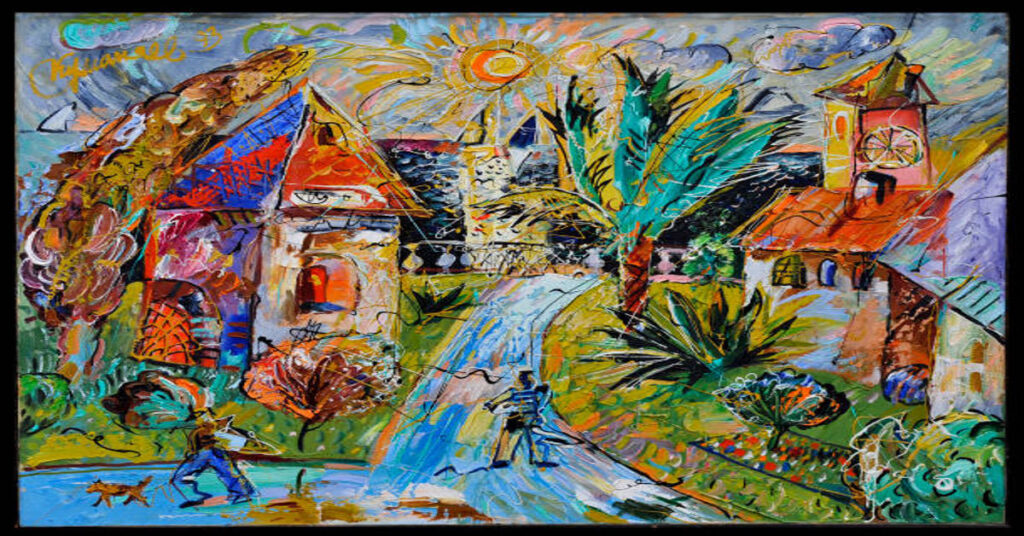
Lancelot Ribeiro’s artistic style is characterized by a dynamic interplay between abstraction and figurative elements. While some of his works are highly abstract, they often retain traces of narrative or symbolic representation, hinting at landscapes, figures, or mythological references. A hallmark of his work is the use of vibrant, saturated colors combined with textured surfaces, creating depth and energy within each composition.
Key stylistic features include:
- Color Vibrancy: Ribeiro frequently used contrasting hues to evoke emotion and movement.
- Textural Experimentation: Through layering paint, applying thick impasto, or incorporating mixed media, he achieved tactile surfaces.
- Cultural Synthesis: Indian motifs and Western abstraction coexist, reflecting his bicultural artistic identity.
- Fluid Composition: Even in abstract works, forms flow seamlessly, guiding the viewer’s eye across the canvas.
His ability to merge diverse influences while maintaining a cohesive visual language is a defining element of his legacy.
4. Influences on Ribeiro’s Work
Ribeiro’s work was shaped by a range of influences spanning geographic, cultural, and stylistic boundaries. Some notable influences include:
- Indian Visual Culture – Religious iconography, folk art, and traditional patterns informed his sense of design and symbolism.
- European Modernism – Exposure to Cubism, Surrealism, and Abstract Expressionism inspired his exploration of form and color.
- Contemporary Artists – Observing contemporaries in London, Ribeiro adopted experimental techniques and incorporated innovative compositional approaches.
- Travel and Cultural Immersion – His journeys across Europe and occasional returns to India allowed him to absorb diverse visual languages, enriching his palette and thematic repertoire.
By synthesizing these influences, Ribeiro’s work transcended simple categorization, embodying a global yet personal aesthetic.
5. Techniques and Mediums
Lancelot Ribeiro experimented with multiple mediums, showcasing versatility in both execution and presentation. His primary techniques and materials included:
| Medium | Technique | Notable Use |
|---|---|---|
| Oil on canvas | Layering, blending, impasto | Abstract and figurative works |
| Watercolor | Transparent washes, controlled bleeding | Landscape and atmospheric studies |
| Acrylic | Bold, quick-drying color applications | Modernist experiments |
| Mixed Media | Collage, texture, unconventional materials | Experimental compositions |
| Ink and Pencil | Line work, sketching, preliminary studies | Preparatory drawings and detailed sketches |
This diverse technical repertoire enabled him to approach each project with the appropriate medium, tailoring his approach to the concept, theme, and desired visual effect.
6. Key Themes and Motifs
Ribeiro’s work is not only visually striking but also thematically rich. Recurring motifs in his paintings include:
- Nature and Landscapes – Interpreted both literally and abstractly, representing the intersection of observation and imagination.
- Mythology and Symbolism – Subtle references to Indian legends, spiritual symbols, and universal archetypes.
- Urban Life and Modernity – Encapsulating the energy of contemporary cities, reflecting his experiences in London.
- Human Emotion and Form – Expressed through abstraction, distortion, and color modulation rather than direct figurative representation.
These themes indicate a deep engagement with both external realities and internal psychological landscapes, highlighting his intellectual and artistic depth.
7. Notable Works
While Ribeiro’s catalog includes numerous paintings and drawings, certain works stand out for their impact and recognition. Some examples include:
| Work | Year | Medium | Significance |
|---|---|---|---|
| “Abstract Landscape with Figures” | 1965 | Oil on canvas | Early exploration of combining abstraction with figurative hints |
| “City Rhythm” | 1972 | Acrylic on canvas | Captures energy of urban London |
| “Mystic Forms” | 1980 | Mixed media | Incorporates Indian motifs into modernist abstraction |
| “Vibrant Horizons” | 1990 | Oil on canvas | Mature style, rich color palette, and fluid composition |
| “Meditative Forms” | 2000 | Watercolor | Late-career work emphasizing subtlety and atmospheric depth |
These works demonstrate his evolving approach to form, color, and thematic exploration over decades.
8. Exhibitions and Recognition
Ribeiro exhibited extensively, particularly in London and international art circles. Key aspects of his exhibition history include:
- Solo Exhibitions – Focused on major developments in his style, showcasing thematic series.
- Group Exhibitions – Positioned alongside contemporaries, highlighting dialogue between Eastern and Western modernism.
- International Exposure – Some works featured in European galleries, broadening his audience and influence.
His exhibitions were often praised for their vibrant use of color, emotive impact, and innovative blending of cultural motifs.
9. Critical Reception
Critics often highlighted Ribeiro’s ability to synthesize complex influences without losing artistic coherence. Reviews frequently praised:
- Bold color usage and dynamic compositions
- Harmonious integration of abstraction and figuration
- Cross-cultural perspective, bridging Indian heritage and Western modernism
Some critics noted the challenge of categorizing Ribeiro within a single art movement, reflecting the originality and multidimensional nature of his work.
10. Contributions to Modern Art
Lancelot Ribeiro contributed significantly to the discourse of modern Indian art in the diaspora. His contributions include:
- Cultural Synthesis – Bridging East and West through visual language
- Pedagogical Influence – Inspiring younger artists exploring cross-cultural artistic identity
- Innovative Techniques – Expanding the scope of color and form in modernist painting
- Legacy in Galleries – Works preserved in public and private collections, ensuring continued influence
Through these contributions, Ribeiro’s work remains a reference point for students, scholars, and art enthusiasts exploring transnational modern art.
11. Personal Philosophy and Approach
Ribeiro believed that art should reflect both internal emotion and external observation. He often stated that the act of painting was as much about personal exploration as about engaging viewers. His philosophy emphasized:
- Experimentation over strict adherence to rules
- Emotional resonance through color and composition
- Openness to cultural influences
- Continuous evolution throughout his career
This approach allowed him to maintain a dynamic and evolving artistic practice over decades.
12. Teaching and Mentorship
In addition to producing art, Ribeiro mentored emerging artists, emphasizing experimentation, cultural awareness, and personal expression. He encouraged students to:
- Explore cross-cultural inspirations
- Experiment with multiple mediums
- Develop a personal visual vocabulary
- Consider emotional and symbolic aspects of art
His role as a mentor amplified his impact, contributing to the development of a new generation of artists.
13. Legacy and Influence
Ribeiro’s legacy is multifaceted, including:
- Artistic Influence – Inspiring artists to explore cross-cultural synthesis
- Cultural Dialogue – Bridging Western modernist techniques with Indian aesthetics
- Institutional Recognition – Works preserved in museums, galleries, and private collections
- Intellectual Contribution – Inspiring discussion on identity, diaspora, and modern art
He remains an important figure in discussions about the evolution of Indian modern art within global contexts.
14. Challenges and Obstacles
Like many artists navigating cross-cultural contexts, Ribeiro faced challenges such as:
- Recognition in mainstream Western art circles
- Balancing Indian heritage with modernist experimentation
- Navigating the commercial pressures of the art market
- Maintaining creative freedom while adapting to evolving trends
Despite these obstacles, Ribeiro continued to innovate, producing a diverse and influential body of work.
15. Summary Table: Key Facts About Lancelot Ribeiro
| Aspect | Details |
|---|---|
| Birth | 1933, Bombay, India |
| Education | Studied in London, exposure to modernist movements |
| Style | Abstract with figurative hints, vibrant color, textured surfaces |
| Influences | Indian visual culture, European modernism, contemporary artists |
| Mediums | Oil, acrylic, watercolor, mixed media, ink |
| Themes | Nature, urban life, mythology, human emotion |
| Legacy | Cross-cultural influence, mentoring, exhibitions, art preservation |
16. Conclusion
Lancelot Ribeiro represents a significant figure in modern art, illustrating how personal identity, cultural heritage, and modernist experimentation can coexist in a cohesive and influential artistic practice. His vibrant colors, textured surfaces, and thematic richness capture the imagination while reflecting a life devoted to exploring visual expression. Ribeiro’s career demonstrates that art can transcend geographic boundaries and cultural expectations, offering insights into the possibilities of creativity in a globalized world. His enduring legacy lies not only in his artwork but also in his contributions to fostering dialogue between cultures and inspiring future generations of artists.
Frequently Asked Questions (FAQs)
1. Who was Lancelot Ribeiro?
Lancelot Ribeiro was an Indian-born artist who developed a modernist style while working in London, blending Eastern and Western influences.
2. What are the main characteristics of his artwork?
Ribeiro’s work features vibrant colors, abstract compositions with figurative hints, textured surfaces, and cross-cultural motifs.
3. Which mediums did Ribeiro use?
He used oil, acrylic, watercolor, ink, pencil, and mixed media to explore form, color, and texture.
4. What themes did Ribeiro explore in his paintings?
His themes include nature, urban life, mythology, human emotion, and cultural synthesis.
5. What is Lancelot Ribeiro’s legacy?
Ribeiro’s legacy lies in cross-cultural art synthesis, mentorship, international exhibitions, and influence on modern Indian diaspora art.