
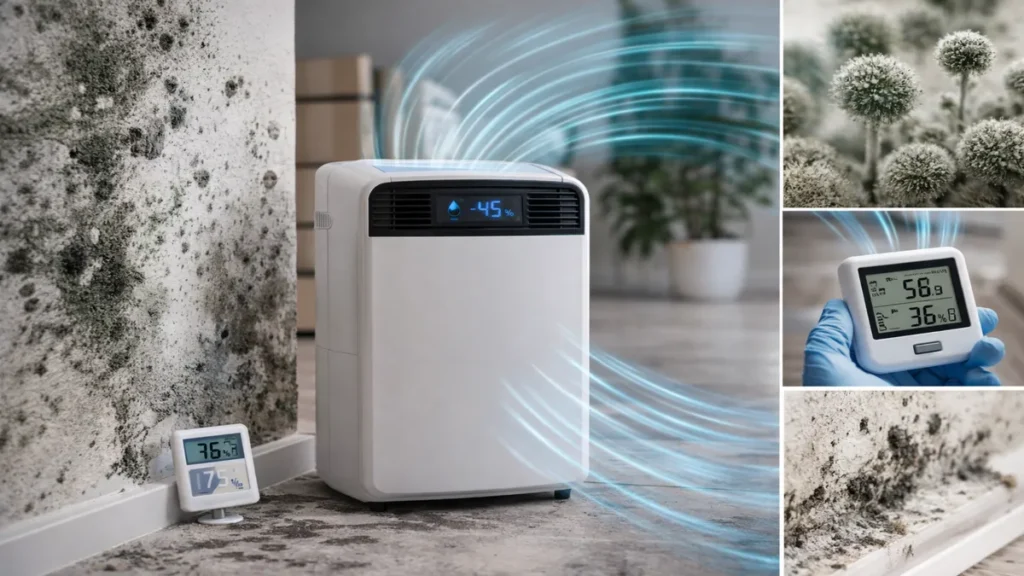
Mould dehumidification is the practice of reducing excess moisture in indoor air to prevent mould from forming and spreading. In practical terms, it means controlling humidity so that mould spores do not find the damp conditions they need to grow on walls, ceilings, furniture, or within insulation. Most mould problems in buildings are not caused by a lack of cleaning, but by an excess of moisture from leaks, condensation, poor ventilation, or everyday activities such as cooking and showering.
By lowering humidity, dehumidification removes one of mould’s essential growth requirements. It does not sterilise the air or destroy spores, which are always present in the environment, but it prevents them from becoming active. This makes dehumidification one of the most effective preventive tools available for managing mould risk in homes, offices, schools, and healthcare facilities.
Understanding mould dehumidification therefore means understanding the relationship between air, water, temperature, and biological growth inside buildings. It involves physics, building design, human behaviour, and environmental health. When applied correctly and consistently, dehumidification becomes not just a technical solution but a long-term strategy for maintaining dry, healthy indoor environments.
Understanding Mould and Moisture
Mould is a type of fungus that reproduces through microscopic spores floating in the air. These spores are harmless until they land on a surface that is sufficiently damp, warm, and still. At that point, they can germinate and form visible colonies. Bathrooms, kitchens, basements, and poorly ventilated bedrooms are particularly vulnerable because moisture accumulates there easily and often remains trapped.
Moisture inside buildings comes from many sources. Rainwater can enter through leaks in roofs or walls. Condensation forms when warm, humid air touches cold surfaces such as windows or uninsulated exterior walls. Everyday activities release litres of water vapour into the air each day, especially in households with multiple occupants. Without adequate ventilation or moisture control, this vapour accumulates, raising indoor humidity to levels that support mould growth.
“Mould is rarely the problem itself. Moisture is the problem that allows mould to exist.” — Indoor air quality consultant
How Dehumidification Works
Dehumidification works by physically removing water vapour from the air. Most domestic dehumidifiers draw in humid air, cool it so that moisture condenses into liquid water, collect that water in a tank or drain, and then release the drier air back into the room.
There are two main technologies used in dehumidification. Refrigerant dehumidifiers use cooling coils and are most efficient in warmer environments. Desiccant dehumidifiers use moisture-absorbing materials and perform better in cooler spaces such as unheated basements or garages.
“Dehumidifiers don’t kill mould. They remove the moisture that mould needs to grow.” — Environmental health specialist
Humidity Targets and Comfort Balance
| Guideline Area | Recommended Relative Humidity | Purpose |
|---|---|---|
| General living spaces | 30–50% | Comfort and mould prevention |
| Basements and crawl spaces | Below 50% | Prevent dampness and fungal growth |
| Archives and libraries | Around 40% | Protect materials from moisture damage |
| Hospitals and clinics | 40–50% | Balance infection control and comfort |
Maintaining humidity within these ranges also reduces static electricity, protects wooden furniture from warping, and prevents condensation on windows and walls.
Comparing Dehumidification Approaches
| Approach | Suitable For | Advantages | Limitations |
|---|---|---|---|
| Portable unit | Single rooms, small flats | Affordable, flexible | Limited coverage |
| Whole-house system | Entire homes | Automatic, uniform control | Higher cost |
| Desiccant unit | Cold or unheated areas | Works in low temperatures | Uses more energy |
| Integrated HVAC control | Large buildings | Centralised management | Requires professional design |
The right approach depends on building size, climate, occupancy patterns, and the severity of moisture problems.
Expert Perspectives
“Most mould problems are moisture problems in disguise. If you don’t manage the humidity, mould will always find a way back.” — Indoor air quality consultant
“After floods or leaks, rapid drying with dehumidifiers and airflow can prevent a minor incident from becoming a major mould infestation.” — Building restoration professional
Integrating Dehumidification into Daily Life
Effective mould dehumidification involves more than buying a machine. It requires thoughtful placement, regular emptying or drainage, and periodic monitoring of humidity levels using a hygrometer.
Dehumidification should also be combined with fixing leaks, improving ventilation, insulating cold surfaces, and managing moisture-producing activities.
Common Misconceptions
A common misconception is that air conditioning alone is enough to control humidity. While AC removes some moisture, it is not designed to maintain stable humidity year-round.
Another misconception is that visible mould is the only problem. In reality, mould often grows behind walls or under carpets where it remains unseen but still affects air quality.
Takeaways
- Mould dehumidification reduces indoor humidity to prevent mould growth
- Mould thrives on moisture, not dirt or neglect alone
- Dehumidifiers prevent growth but do not kill spores
- Ideal indoor humidity is between 30 and 50 percent
- Different technologies suit different environments
- Early control prevents major mould problems
- Dehumidification improves comfort and respiratory health
Conclusion
Mould dehumidification is a quiet but powerful tool in maintaining healthy buildings. By focusing on moisture rather than symptoms, it addresses the fundamental condition that allows mould to exist. It transforms indoor environments from damp, vulnerable spaces into dry, stable ones where biological growth struggles to take hold.
Used wisely and consistently, dehumidification becomes part of a broader commitment to healthier living, sustainable building maintenance, and long-term comfort.
FAQs
What is mould dehumidification?
It is the process of reducing indoor humidity to prevent mould growth.
Does a dehumidifier remove mould?
It prevents mould growth but does not remove or kill existing mould.
What humidity level prevents mould?
Generally between 30 and 50 percent relative humidity.
Where should a dehumidifier be placed?
In damp areas such as basements, bathrooms, or poorly ventilated rooms.
Is dehumidification enough on its own?
It works best when combined with ventilation, insulation, and leak repair.