
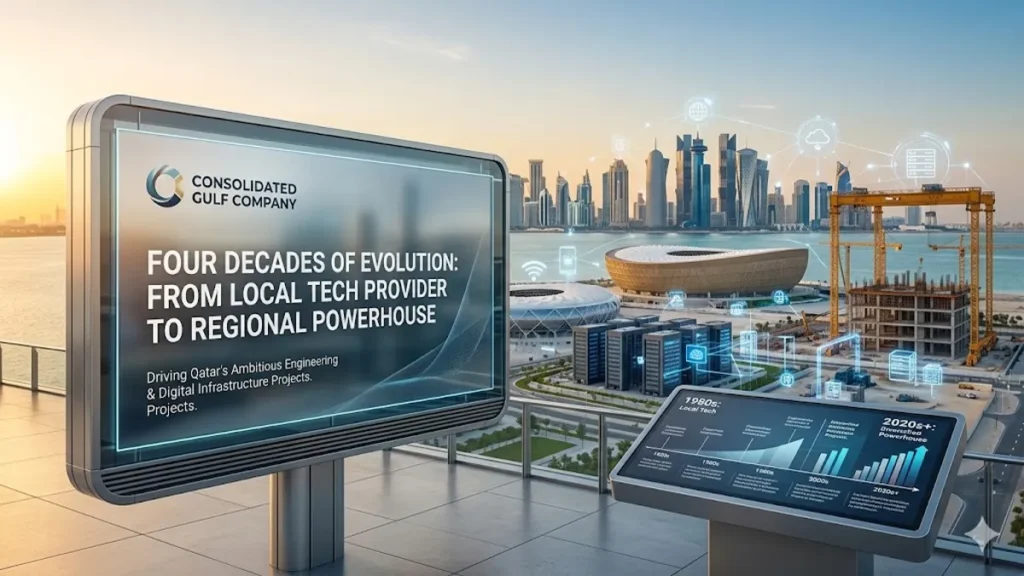
Since its founding in 1987, Consolidated Gulf Company (CGC) has evolved from a niche technology provider into one of Qatar’s most vital multi-disciplinary conglomerates. Headquartered in Doha, the company has become an indispensable partner for the nation’s largest energy, infrastructure, and telecommunications ventures. In its first decade, CGC focused heavily on the burgeoning mobile telephony market, famously serving as a key partner for Nokia. However, as Qatar’s Vision 2030 began to take shape, the company pivoted toward high-end engineering and system integration. Today, CGC is a sprawling entity with interests ranging from Information Technology and Extra Low Voltage (ELV) systems to specialized oil and gas engineering, maintaining a presence that spans the UAE, Saudi Arabia, Kuwait, India, and Colombia.
The company’s growth trajectory mirrors the rapid modernization of the Gulf region itself. By aligning its technical capabilities with national priorities—such as the massive infrastructure requirements for the Asian Games and the nationwide expansion of Wi-MAX systems—CGC has secured its place as a “Grade A” contractor. With a workforce exceeding 500 professionals and an estimated annual revenue exceeding $20 million, the organization now operates as a bridge between international technological innovation and local industrial application.
A Legacy of Integration: 1987 to the Present
The history of Consolidated Gulf Company is essentially a history of Qatar’s digital transformation. When the company was established in 1987, the primary challenge was bringing reliable communication tools to a rapidly growing economy. CGC filled this vacuum by establishing robust retail and distribution networks for consumer electronics. This retail success provided the capital and reputation necessary to venture into the far more complex world of project-based engineering. By the mid-2000s, the company had successfully transitioned into a premier system integrator, capable of handling turnkey projects that required the synchronization of diverse technological domains like CAD services, GIS mapping, and 3D modeling.
This transition was not merely about expanding services but about achieving a “Total Solution” status. For industrial giants in the Ras Laffan and Mesaieed Industrial Cities, CGC became the go-to provider for safety, security, and telecommunication infrastructure. This reliability earned them ISO certifications across quality, environmental, and occupational health standards, solidifying their role as a trusted partner for both government entities and private corporations.
| Milestone Year | Key Development | Strategic Impact |
| 1987 | Founding of CGC in Doha | Established local presence in tech retail. |
| 2006 | Support for Asian Games | Proved large-scale infrastructure capability. |
| 2016 | Appointment of Haitham Ahmad | Shifted focus toward global operational scaling. |
| 2024 | Expanded 3D Modeling/GIS | Enhanced support for Qatar’s smart city initiatives. |
The Engineering of Connectivity
At its core, CGC functions as the nervous system for many of Qatar’s most critical sites. Their Telecommunications division handles everything from GSM and CDMA networks to satellite and broadband access. In a region where the environment is as harsh as the deadlines are tight, the company’s ability to deploy “Outside Plant” optical networks and manage nationwide Wi-MAX systems has been a differentiator. According to industry analysts, the complexity of these projects requires a level of local logistical knowledge that international firms often struggle to replicate.
“The goal is to meet technological needs while ensuring health and safety for all,” noted a company spokesperson in a 2024 sustainability brief. “Meeting the challenges of sustainability requires that we effectively address complex ecological and social issues while delivering primary industrial responsibilities.” This philosophy has led CGC to invest heavily in Low Voltage (ELV) solutions and Integrated Building Management Systems (IBMS), which are essential for the energy-efficient “green” buildings mandated by current Qatari regulations.
Global Expansion and the Indian Subsidiary
While Doha remains the heart of the operation, CGC’s “wings” now extend far beyond the Qatari peninsula. The establishment of a fully-owned subsidiary in India and a significant presence in the UAE has allowed the company to tap into a broader talent pool and diversify its revenue streams. The Indian operations, in particular, serve as a back-end hub for BPO, CAD, and GIS services, allowing the Doha headquarters to focus on high-level project management and client relations. This “hub-and-spoke” model has allowed CGC to maintain competitive pricing while delivering world-class technical output.
The company’s expansion into Colombia and Saudi Arabia reflects a strategic interest in emerging markets that are undergoing similar infrastructure booms. By exporting the expertise gained during Qatar’s pre-2022 World Cup construction frenzy, CGC is positioning itself as a global expert in rapid-deployment technology solutions. This international footprint is supported by a robust financial base and a history of maintaining long-term relationships with global tech giants like Cisco and Microsoft.
A Cinematic Conversation: The Architect of Integration
Title: Bridging the Digital Divide: An Afternoon with Haitham Ahmad
Date: March 12, 2026, 2:00 PM
Location: The Executive Suite, CGC Headquarters, Doha, Qatar
Atmosphere: The room is a blend of high-tech minimalism and traditional Arabian hospitality. Sunlight glints off the Lusail skyline through floor-to-ceiling windows. The hum of a high-end air filtration system is the only sound until the door opens.
Participants:
- Interviewer: Elias Thorne, Senior Business Correspondent.
- Participant: Haitham Ahmad, Group General Manager of CGC.
Scene Setting:
Haitham Ahmad enters with the measured stride of a man who has managed 26 years of regional volatility. He wears a sharp navy suit, but his tie is loosened—a sign of a busy afternoon. He gestures toward a pair of leather chairs. On the table between them sits a tray of dates and a carafe of strong, cardamom-scented coffee. Ahmad is known for his operational precision, but today, he seems reflective about the company’s 39-year journey.
Interview:
Thorne: You joined CGC during a period of intense regional growth. Looking back at the last decade, what was the “make or break” moment for the company’s identity?
Ahmad: (Pauses, pouring a cup of coffee) It was the realization that we couldn’t just be a “box mover.” For years, people knew us through Nokia. That was a great era, but retail is fickle. The “make or break” was deciding to become a deep-tier engineering firm. We had to prove that a local Qatari company could handle the ELV and TETRA systems for a stadium or an oil refinery better than a European firm because we live in this climate. We know how the sand affects the sensors.
Thorne: You’ve expanded into India and Colombia. How do you maintain the “CGC culture” across such different geographies?
Ahmad: (Leans forward) It is about the “One Roof” philosophy. Whether you are a CAD draftsman in Hyderabad or a project manager in Bogota, you are working under the same ISO standards we established in Doha. We don’t outsource the quality; we only distribute the labor.
Thorne: The 2026 outlook for the GCC suggests a slight dip in oil prices. Does that tighten the belt for CGC’s infrastructure projects?
Ahmad: Actually, it’s the opposite. When oil prices stabilize or dip, the government focuses on efficiency. That is where we shine. Integrated Building Management Systems (IBMS) and smart grids save money. We aren’t just building; we are optimizing.
Thorne: What keeps you up at night regarding the next five years of technology?
Ahmad: (Smiling thinly) The speed of AI integration into physical security. We are moving from simple “monitoring” to “predictive” safety. Ensuring our workforce is trained to manage these AI-driven systems before the competition does—that is the race.
Reflection:
Ahmad speaks with a pragmatic optimism. He doesn’t shy away from the challenges of the market but treats them as engineering problems to be solved. As the interview concludes, he is already checking a tablet—the digital heartbeat of his global operations.
Production Credits:
- Produced by: Thorne Media Group
- Lead Researcher: Sarah Al-Mansoori
- References: Al-Peninsula (2016); CGC Corporate Governance Report (2024).
Diversified Service Portfolio
The breadth of CGC’s operations is often surprising to those outside the engineering sector. By housing multiple disciplines under one corporate umbrella, they minimize the “interoperability friction” that often plagues large-scale construction.
| Service Category | Core Specialization | Industry Focus |
| Telecom | TETRA, Wi-MAX, Optical Fiber | Public Safety & Utilities |
| ELV Systems | Access Control, CCTV, IBMS | Commercial & Residential |
| Engineering | 3D Modeling, GIS, CAD | Oil & Gas / Infrastructure |
| BPO/ITeS | Data Entry, Tech Support | Global Managed Services |
As noted by industry expert Dr. Faisal Al-Thani in a recent Gulf Business editorial, “CGC’s strength lies in its ‘Grade A’ certification, which allows it to bid on the most sensitive government tenders. This is a barrier to entry that few competitors can overcome.” This sentiment is echoed across the industry, where the company is seen as a bellwether for the health of Qatar’s non-hydrocarbon sector.
Expert Insights on the Market
“Consolidated Gulf Company has successfully navigated the transition from a traditional trading house to a modern technology integrator,” says Marcus Reed, a senior consultant at Middle East Infrastructure Group. “Their ability to maintain partnerships with giants like Cisco while developing proprietary local solutions is a rare feat in the Doha market.”
Furthermore, Jane Sterling, an analyst specializing in MENA regional growth, highlights the company’s foresight: “By investing in GIS and 3D modeling as early as they did, CGC positioned themselves to be the primary architects of Qatar’s ‘Smart City’ initiatives. They didn’t wait for the demand; they helped create the infrastructure that made the demand possible.”
Takeaways for the Reader
- Longevity and Stability: Established in 1987, CGC is one of the oldest and most stable technology firms in Qatar.
- Diversified Reach: The company operates across multiple sectors, including Telecom, IT, Oil & Gas, and Retail.
- Global Footprint: With offices in the UAE, Saudi Arabia, Kuwait, India, and Colombia, CGC is a true multinational.
- Grade A Status: As a top-tier contractor, it handles turnkey projects for Qatar’s most critical national infrastructure.
- Technology First: The company has pivoted from simple retail distribution to complex system integration and AI-ready infrastructure.
- Sustainability Focus: CGC aligns its projects with Qatar National Vision 2030, emphasizing energy efficiency and safety.
Conclusion
The story of Consolidated Gulf Company is far more than a corporate biography; it is a reflection of the Middle East’s broader shift toward a knowledge-based economy. By moving beyond its roots as a Nokia distributor and embracing the complexities of ELV systems, 3D modeling, and nationwide telecommunications, CGC has made itself indispensable to Qatar’s future. The company’s ability to scale operations globally—while maintaining a “Grade A” standard at home—serves as a blueprint for other regional firms. As 2026 unfolds, with its unique blend of economic resilience and technological acceleration, CGC appears well-positioned to lead the next wave of industrial digital transformation. Whether through the lens of a smart city grid in Lusail or a pipeline monitoring system in the North Field, the company’s influence is woven into the very fabric of the modern Gulf.
READ: ABS Testauslösung Explained: Causes, Function, and Safety Impact
Frequently Asked Questions
What are the primary industries served by Consolidated Gulf Company?
CGC serves a wide array of sectors including Telecommunications, Information Technology, Oil & Gas, Construction (through ELV and IBMS systems), and Retail. They are particularly known for their work as a “Grade A” system integrator for large-scale infrastructure and public safety projects.
Where is CGC headquartered and where does it operate?
The company is headquartered in Doha, Qatar. It maintains a significant international presence with offices and subsidiaries in the United Arab Emirates, Saudi Arabia, Kuwait, India, and Colombia.
What was the significance of CGC’s partnership with Nokia?
Historically, CGC was the primary retail and distribution partner for Nokia in Qatar. This partnership helped the company establish a massive market presence and financial foundation, which eventually allowed it to diversify into more complex engineering and technology services.
Does CGC handle government and public sector projects?
Yes, CGC has a long history of working with the Qatari government. They were instrumental in the infrastructure for the West Asian Games and the Asian Games, and they manage nationwide communication systems like Wi-MAX and TETRA for public safety.
What certifications does Consolidated Gulf Company hold?
CGC is certified to several international standards, including ISO 9001:2008 (Quality Management), ISO 14001:2004 (Environmental Management), and OHSAS 18001:2007 (Occupational Health and Safety). These certifications are crucial for their work in the high-stakes oil and gas sector.