
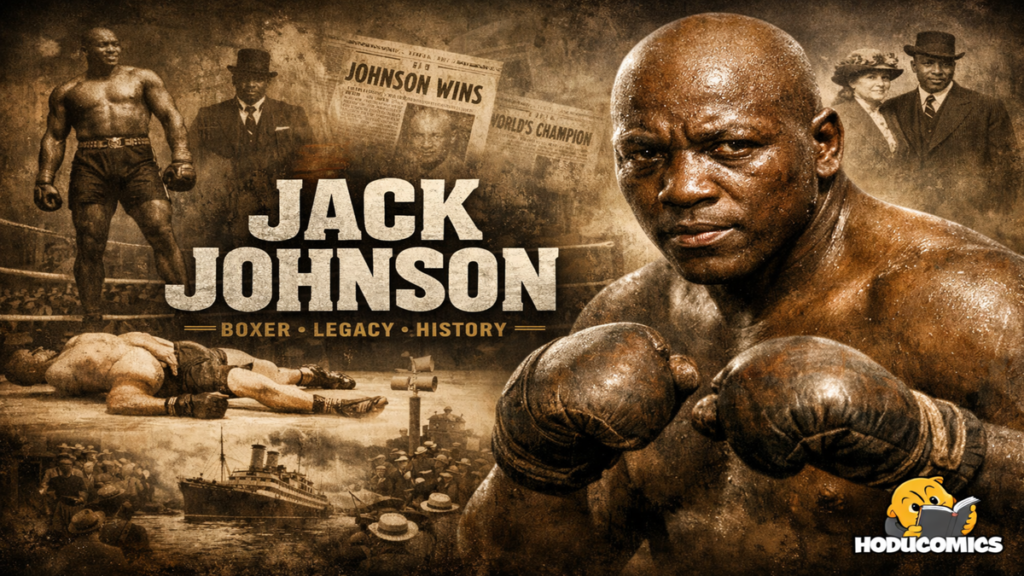
I have come to understand that the story of Jack Johnson cannot be reduced to boxing alone. For those seeking to learn about Jack Johnson, he was the first Black heavyweight champion of the world, winning the title in 1908, but his legacy extends far beyond the ring. He was a figure who challenged not only opponents, but the deeply entrenched racial hierarchies of his time. His life offers a lens into early twentieth-century America, where sport, race, and identity intersected in ways that were often volatile and transformative.
From the beginning, Johnson’s presence disrupted expectations. He did not merely participate in boxing. He redefined it, bringing a calm, strategic approach that contrasted with the aggressive style of his contemporaries. More importantly, he carried himself with a confidence that defied social norms. In an era when Black Americans were expected to remain invisible in positions of power, Johnson’s visibility was itself a form of resistance.
The significance of his career becomes clear when placed within its historical context. His victories provoked national reactions, revealing the anxieties and divisions of the time. Understanding Jack Johnson means examining both his achievements and the reactions they provoked. It is a story of skill and defiance, of triumph and consequence, and of a legacy that continues to resonate in discussions of sport and society.
Early Life and the Formation of Identity
I have often reflected on how Johnson’s early years shaped the person he became. Born in 1878 in Galveston, Texas, he grew up in a world defined by the aftermath of slavery and the realities of segregation. His parents, both formerly enslaved, instilled in him a sense of independence and resilience that would later define his public persona.
Unlike many athletes whose early lives follow a clear path toward sport, Johnson’s journey was less direct. He worked in manual labor jobs and spent time observing local boxing matches before stepping into the ring himself. These early experiences were formative. They exposed him to both opportunity and limitation, teaching him that success would require not only talent but persistence.
Johnson’s approach to boxing was unconventional. He developed a defensive style that emphasized patience and control. Rather than overwhelming opponents with force, he outmaneuvered them, conserving energy and exploiting weaknesses. This method required discipline and intelligence, qualities that set him apart.
“Johnson’s style was revolutionary,” wrote historian Geoffrey Ward. “He fought with his mind as much as his body.” This intellectual approach to boxing would become one of his defining characteristics, influencing generations of fighters who followed.
Confronting the Color Line
I have come to see that Johnson’s rise cannot be understood without acknowledging the barriers he faced. At the time, boxing was governed by an unofficial but widely enforced “color line” that prevented Black fighters from competing for the heavyweight championship. This exclusion reflected broader societal norms that sought to limit opportunities for Black Americans.
Johnson’s pursuit of the title was marked by frustration. He challenged champions repeatedly, often being ignored or denied opportunities. This resistance was not merely about sport. It was about maintaining a social order in which Black success was constrained.
When Johnson finally secured a match against Tommy Burns in 1908, the significance of the fight extended beyond the ring. It represented a challenge to the very structure of the sport. Johnson’s victory, achieved through a dominant performance, shattered the color line and forced the boxing world to confront its own contradictions.
The reaction was immediate and intense. For some, Johnson’s victory was a moment of pride and possibility. For others, it was perceived as a threat. This division reflected the broader tensions of the era, highlighting how deeply sport was intertwined with social identity.
The Burden of Visibility
I have observed that Johnson’s success brought with it a level of scrutiny that few athletes have experienced. As the first Black heavyweight champion, he became a symbol, whether he chose to or not. His actions were interpreted not only as personal choices but as statements about race and power.
Johnson did not conform to expectations. He lived openly, displaying wealth and confidence in ways that challenged prevailing norms. His relationships, particularly with white women, drew significant attention and criticism. These choices were seen by many as provocative, intensifying the backlash against him.
This visibility placed Johnson in a precarious position. He was celebrated and condemned, admired and resented. The contradictions of his public image reflect the complexities of his time. He was both a pioneer and a target, navigating a landscape that was often hostile.
“Johnson understood the power of his presence,” notes historian Randy Roberts. “He refused to diminish himself to make others comfortable.” This refusal is central to his legacy, marking him as a figure who challenged not only opponents but expectations.
The Fight Against James J. Jeffries
I have come to view the 1910 fight between Johnson and James J. Jeffries as one of the most significant events in sports history. The match was framed as a contest not just between two fighters, but between racial identities. Jeffries, a former champion, was portrayed as the “Great White Hope,” a figure who could restore a perceived order.
The anticipation surrounding the fight was immense. It attracted national attention, with media coverage reflecting the racial tensions of the time. The event was more than a sporting contest. It was a cultural moment.
Johnson’s performance was decisive. He controlled the fight with precision, ultimately defeating Jeffries and reaffirming his status as champion. The victory was a demonstration of skill and composure, but its implications extended far beyond the ring.
The aftermath was marked by violence. Race riots erupted in multiple cities, underscoring the deep divisions within American society. The fight revealed the extent to which sport could serve as a catalyst for broader social reactions.
Legal Challenges and Exile
I have found that Johnson’s legal troubles are inseparable from his story. In 1913, he was convicted under the Mann Act, a law originally intended to combat human trafficking. Many historians view the case as racially motivated, targeting Johnson for his personal relationships.
Facing imprisonment, Johnson chose to leave the United States, entering a period of exile that took him across Europe and South America. During this time, he continued to fight, but his absence from the American boxing scene diminished his influence.
Exile represented both a loss and a continuation. While he was removed from the center of American sport, he remained a global figure. His experiences abroad reflect the international dimensions of his career, highlighting how his impact extended beyond national boundaries.
“Johnson’s exile was a consequence of his defiance,” writes Roberts. It illustrates the costs of challenging societal norms, particularly in a context where those norms were deeply entrenched.
The Later Years and Decline
I have come to see Johnson’s later years as a period of transition. After losing the title to Jess Willard in 1915, his dominance in the ring diminished. Age, changing circumstances, and the evolving nature of the sport contributed to this decline.
Despite these changes, Johnson remained a figure of interest. His life continued to attract attention, reflecting the enduring fascination with his story. He spent his later years working in various roles, including as an entertainer and public figure.
His death in 1946 marked the end of a remarkable life, but not the end of his influence. His story continued to be told, reinterpreted, and reassessed, becoming part of the broader narrative of American history.
Legacy and Historical Significance
I have come to understand that Johnson’s legacy is multifaceted. He was a pioneering athlete, a cultural figure, and a symbol of resistance. His impact on boxing is evident in the evolution of fighting styles, particularly the emphasis on strategy and defense.
Beyond sport, his significance lies in his challenge to racial norms. He demonstrated that excellence could not be confined by prejudice, even in the face of significant opposition. His life serves as a reminder of the complexities of progress, where achievements are often accompanied by resistance.
“Johnson changed what was possible,” notes cultural historian Gerald Early. This change extends beyond boxing, influencing broader discussions about race, identity, and representation.
Takeaways
Jack Johnson’s life illustrates the intersection of sport and society, showing how athletic achievement can challenge social norms and provoke broader cultural conversations. His career reflects both the possibilities and the limitations of his time, offering insights into the dynamics of race and power. His legacy continues to influence both boxing and the ongoing struggle for equality, reminding us that progress often comes through individuals willing to defy expectations.
Conclusion
I have come to believe that Jack Johnson’s story is not simply about a boxer who became champion. It is about a man who redefined what it meant to be visible, to be successful, and to be unapologetically oneself in a society that resisted such expressions.
His life was marked by contradiction and complexity, reflecting the challenges of his era. Yet within those challenges, he carved out a legacy that endures. His influence can be seen in the athletes who followed, in the conversations he helped to initiate, and in the ongoing pursuit of equality.
In the end, Jack Johnson’s story is a reminder that history is shaped not only by events, but by individuals who challenge the boundaries of what is possible.
Read: Fetid Key OSRS Guide: How to Get and Use the Fetid Key OSRS in Slayer Tower
FAQs
Who was Jack Johnson?
Jack Johnson was the first Black heavyweight boxing champion, known for his skill and his role in challenging racial barriers.
Why is he historically important?
He broke the color line in boxing and became a symbol of resistance against racial discrimination.
What was the Fight of the Century?
It was his 1910 match against James J. Jeffries, representing broader racial tensions.
Why did he go into exile?
He fled the United States after being convicted under the Mann Act, a case widely viewed as unjust.
What is his legacy today?
He is remembered as a pioneer who influenced both sports and civil rights.
References
Roberts, R. (1983). Papa Jack: Jack Johnson and the era of white hopes. Free Press.
Ward, G. C. (2004). Unforgivable blackness: The rise and fall of Jack Johnson. Knopf.
Wiggins, D. K. (2004). African Americans in sports. M.E. Sharpe.
Early, G. (2011). Jack Johnson: Rebel sojourner. University of California Press.
U.S. Department of Justice. (2018). Posthumous pardon of Jack Johnson. https://www.justice.gov