
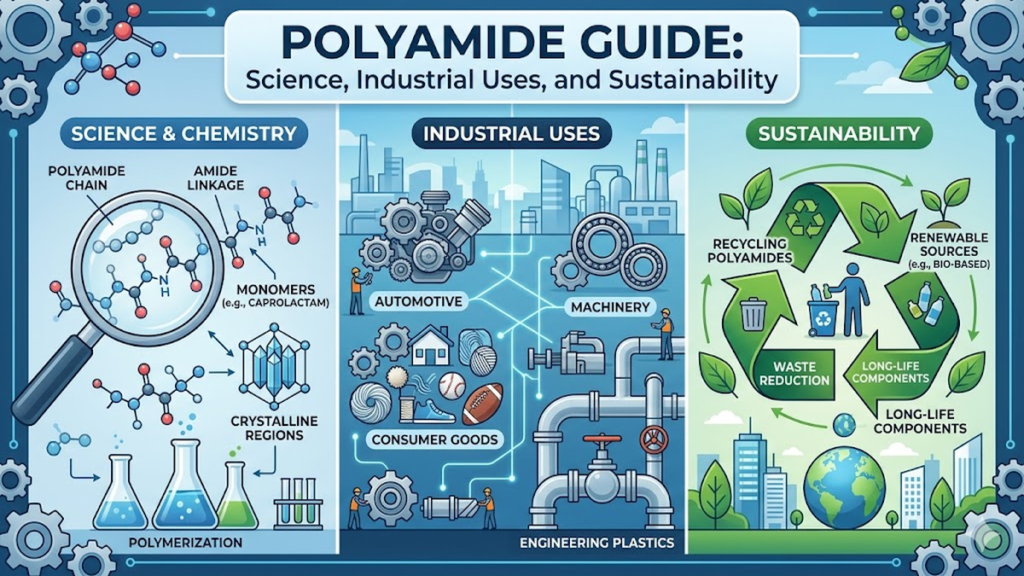
Polyamide, more commonly recognized by its commercial alias, nylon, is a synthetic or natural polymer linked by amide bonds that serves as a cornerstone of modern industrial design. At its core, a polyamide is defined by the repeating $CO-NH$ units in its molecular chain, providing a unique combination of high mechanical strength, thermal stability, and chemical resistance. These properties make it indispensable in sectors ranging from automotive manufacturing—where it replaces heavy metal components to enhance fuel efficiency—to the textile industry, where its elasticity and durability are unmatched. As of 2026, the global polyamide market has surpassed $47 billion, driven by an urgent shift toward lightweight materials in electric vehicles and the rise of bio-based, circular economy solutions.
The history of polyamides is a narrative of chemical triumph, beginning in the laboratories of DuPont in the 1930s. Led by Wallace Carothers, the discovery of Nylon 6,6 revolutionized the textile market, initially as a silk substitute for hosiery and later as a critical material for parachutes during World War II. Today, the family of polyamides has expanded into a complex hierarchy of “aliphatic” nylons and “aromatic” aramids like Kevlar. This article explores the molecular nuances, industrial applications, and the burgeoning sustainable innovations that are redefining how we produce and recycle these essential polymers.
The Chemist’s Canvas: Structure and Synthesis
The versatility of polyamides stems from their specific chemical architecture. They are typically formed through condensation polymerization, a process where monomers—the building blocks of polymers—react to form a long chain while releasing a small molecule, usually water. In the case of Nylon 6,6, the monomers are adipic acid and hexamethylenediamine. The “6,6” designation refers to the six carbon atoms present in each of these precursors.
The physical properties of a polyamide are dictated by the spacing and frequency of its amide groups. In aliphatic polyamides (nylons), the chains are flexible, leading to the elasticity seen in sportswear. Conversely, in aromatic polyamides (aramids), the inclusion of phenyl rings in the backbone creates a rigid, crystalline structure. This molecular rigidity is what allows Kevlar to stop a bullet or withstand the extreme heat of a forest fire.
Comparative Analysis of Leading Polyamides
The following table outlines the distinct characteristics of the most prevalent polyamides used in industrial and consumer sectors today:
| Polyamide Type | Common Name | Key Property | Primary Application |
| PA 6 | Nylon 6 | High impact resistance | Automotive engine covers, nets |
| PA 6,6 | Nylon 6,6 | High melting point ($265$°C) | Airbags, conveyor belts, carpet |
| PA 11 | Rilsan | Bio-derived (Castor oil) | 3D printing, fuel lines |
| Para-Aramid | Kevlar / Twaron | Extreme tensile strength | Body armor, aerospace composites |
| Meta-Aramid | Nomex | Flame resistance | Firefighter gear, electrical insulation |
From Undergarments to Under the Hood
The transition of polyamide from a sheer luxury fabric to a rugged industrial workhorse occurred with remarkable speed. In the automotive sector, “metal replacement” has become a mantra for engineers looking to shed weight. Polyamides are now the standard for intake manifolds, radiator tanks, and even structural brackets. Because polyamides can be reinforced with glass fibers or carbon fillers, they achieve a strength-to-weight ratio that traditional aluminum cannot match.
“The beauty of polyamide lies in its ‘tunability,'” notes Dr. Helena Vance, a senior polymer researcher. “By adjusting the cooling rate during injection molding or adding specific heat stabilizers, we can create a material that is as soft as silk or as hard as a bone.” This adaptability is why the transportation industry currently accounts for approximately 35% of all polyamide consumption globally.
Market Dynamics and Economic Projections
The economic landscape for polyamides is shifting as supply chains stabilize in 2026. While petrochemical feedstocks remain the primary source, volatility in oil prices has accelerated the demand for long-chain polyamides (like PA 12) which offer better dimensional stability and moisture resistance.
| Market Segment (2026) | Market Share (%) | Projected CAGR (2026–2034) |
| Automotive | 36% | 6.2% |
| Electrical & Electronics | 22% | 5.8% |
| Consumer Goods/Textiles | 18% | 4.5% |
| Industrial/Others | 24% | 7.1% |
The Green Frontier: Bio-Polyamides and Circularity
Perhaps the most significant challenge facing the polyamide industry is its environmental footprint. Traditional production is energy-intensive and relies on fossil fuels. Furthermore, polyamides are notoriously difficult to degrade, contributing to the persistent issue of microplastic pollution in marine environments. However, the industry is fighting back with two distinct strategies: bio-based synthesis and chemical recycling.
Bio-polyamides, such as PA 11, are derived from renewable sources like the castor bean. Unlike petroleum-based plastics, these materials have a significantly lower carbon footprint and do not compete with food crops for land. In 2026, bio-based polyamides represent roughly 18% of the total market, a figure expected to double within the decade as brands like Patagonia and Adidas push for “closed-loop” apparel.
Chemical recycling represents the other half of the solution. Unlike mechanical recycling, which can degrade the quality of the plastic, chemical recycling breaks the polymer back down into its original monomers. This allows for the creation of “virgin-quality” recycled nylon. Products like ECONYL®, which uses discarded fishing nets and carpet scraps, have demonstrated that high-performance materials do not have to come from an oil well.
“We are moving away from a linear ‘take-make-waste’ model toward a truly circular economy where the amide bond is never truly broken, only rearranged for a new purpose,” says Marcus Thorne, Chief Sustainability Officer at a leading European chemical conglomerate.
Expert Insights: The Performance Edge
Beyond sustainability, the performance of polyamides continues to evolve. In the realm of 3D printing, PA 12 has become the “gold standard” for functional prototyping due to its excellent detail resolution and mechanical durability. This allows engineers to print complex geometries that would be impossible to manufacture through traditional molding.
In the textile world, the emphasis has shifted toward “intelligent” polyamides. These fibers are engineered to react to environmental stimuli—wicking moisture away more aggressively when body temperature rises or providing enhanced UV protection in high-altitude environments.
“Polyamide remains the king of synthetic fibers because of its recovery properties,” explains textile technologist Sarah Jenkins. “You can stretch a nylon fiber up to 20% of its length and it will snap back to its original shape. That resilience is why your favorite leggings don’t sag after a hundred washes.”
Takeaways: The Polyamide Profile
- Diverse Family: Includes both common nylons (aliphatic) and high-strength aramids (aromatic) like Kevlar.
- Mechanical Superiority: Offers high tensile strength, abrasion resistance, and a high melting point.
- Industry Driver: The automotive sector is the largest consumer, utilizing polyamides for weight reduction and fuel efficiency.
- Thermal Resilience: High-performance grades can withstand continuous operating temperatures above $150$°C.
- Sustainability Shift: Bio-based polyamides and chemical recycling (e.g., ECONYL) are rapidly gaining market share.
- Moisture Sensitivity: Most polyamides absorb water, which can act as a plasticizer, changing their physical properties over time.
Conclusion
The story of polyamide is a testament to the power of molecular engineering. What began as a pursuit of a better stocking has evolved into a material that protects soldiers, powers electric vehicles, and paves the way for a more sustainable textile industry. As we move deeper into the 21st century, the focus is no longer just on what polyamides can do, but how they are made and where they go after their useful life.
The transition toward a circular economy for polyamides is not merely a trend but a necessity. With the advent of advanced chemical recycling and the scaling of bio-based feedstocks, the “nylon” of the future will be defined by its lack of a carbon footprint rather than just its strength. Polyamide remains an essential thread in the fabric of modern life—resilient, adaptable, and increasingly green.
Read: Performance Analytics Guide for Data-Driven Success
FAQs
What is the difference between polyamide and nylon?
In practical terms, there is no difference; nylon is simply a brand name that became the generic term for synthetic polyamides. Technically, “polyamide” is the chemical family name, while “nylon” refers specifically to aliphatic polyamides used in fibers and plastics.
Is polyamide a plastic or a fabric?
It is both. Polyamide is a polymer that can be melted and extruded into fine filaments for fabrics (like hosiery or activewear) or molded into solid plastic components (like gears, bushings, and automotive engine parts).
Is polyamide waterproof?
While polyamide itself does not absorb massive amounts of water compared to natural fibers like cotton, it is “hygroscopic,” meaning it absorbs some moisture. This is why nylon swimwear dries quickly but can feel slightly heavier when wet compared to polyester.
Is polyamide environmentally friendly?
Traditional petroleum-based polyamide has a high environmental impact. However, 2026 has seen a surge in bio-based polyamides (from castor oil) and chemically recycled versions (from fishing nets), which are significantly more eco-friendly and support a circular economy.
How should I wash polyamide clothing?
Polyamide is durable but heat-sensitive. It should be washed in cool or warm water. High heat from a dryer can damage the fibers and cause shrinkage, so air-drying or low-heat settings are recommended to maintain the garment’s elasticity.
References
- Asep Industries. (2024, March 18). The environmental impact of nylon production and recycling. https://www.asepindustries.com.my/post/environmental-impact-nylon
- Britannica, T. Editors of Encyclopaedia. (2026, March 5). Polyamide. Encyclopedia Britannica. https://www.britannica.com/science/polyamide
- Fortune Business Insights. (2026, March 16). Polyamide market size, industry share, forecast, 2034. https://www.fortunebusinessinsights.com/polyamide-market-102374
- Research and Markets. (2026). Long-chain polyamide market report 2026. https://www.researchandmarkets.com/reports/6226349/long-chain-polyamide-market-report
- Save My Exams. (2024, December 23). Formation of polyamides – A level chemistry revision notes. https://www.savemyexams.com/a-level/chemistry/cie/25/revision-notes/35-polymerisation/35-1-condensation-polymerisation/formation-of-polyamides/
- Stellarix. (2025, November 26). Unlocking value: The strategic imperative of polyamide recycling. https://stellarix.com/insights/articles/strategic-imperative-of-polyamide-recycling/