The crispness of a Caesar salad or the structural integrity of a delicate arugula leaf often goes unquestioned by the modern diner. Yet, before the mid-1970s, the path to a dry leaf was a gauntlet of soggy paper towels and precarious hand-swinging. The “Fouineteau” method, named after the French inventor Gilberte Fouineteau, revolutionized this culinary niche by introducing the removable basket and gear-driven centrifugal system we recognize today. By separating the inner perforated vessel from the outer bowl, Fouineteau solved the “central post” problem that had plagued earlier designs, allowing for efficient water extraction without damaging the produce.
While Jean Mantelet—the founder of Moulinex—often shares the spotlight for early drying patents, it was Fouineteau’s specific 1973 design that laid the groundwork for the modern ergonomics of the tool. Her invention shifted the salad spinner from a bulky industrial concept into a streamlined domestic appliance. Today, the “Fouineteau” legacy is felt in every kitchen that prizes the physics of centrifugal force over the messy inefficiency of air-drying. This article explores the engineering brilliance, the historical context of the 1970s kitchen revolution, and why this seemingly simple plastic bowl remains a masterpiece of industrial design.
The Engineering of Aridity: How the Fouineteau Patent Changed Physics
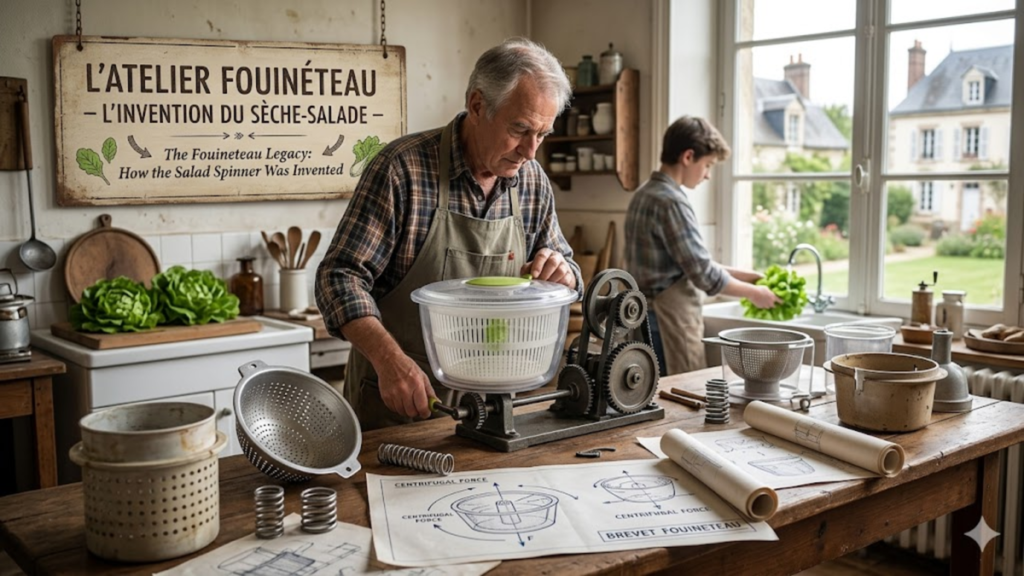
At its core, the Fouineteau design is a study in rotational dynamics. Prior to the 1970s, drying lettuce was a labor-intensive chore. Early “dryers” were essentially wire baskets that required the user to stand outdoors and swing them in a circular motion—a method that was as dangerous for the kitchen walls as it was for the vegetables. Fouineteau’s brilliance was in the internal architecture of the device. By creating a system where an inner basket nested into an outer bowl, she created a self-contained environment for centrifugal force to act.
The physics are straightforward but profound: as the inner basket spins, the water—possessing more mass than the lettuce—is pushed outward through the perforations by inertia. The outer bowl then catches this runoff, preventing a mess. Fouineteau’s patent, US3885321, filed in 1973, specifically improved upon the “central post” design used by her contemporaries. By removing the fixed central axle, she allowed for more volume and easier cleaning, a change that saw the salad spinner move from a novelty item to a permanent fixture on the countertop.
Read: Souvite Cooking Guide: Modern Sous Vide Explained
Table 1: Evolution of the Salad Drying Mechanism
| Period | Primary Method | Major Limitation |
| Pre-1970 | Hand-swinging wire baskets | Messy, physically demanding, inconsistent. |
| 1971 (Mantelet) | Central-post mechanical spinner | Post obstructed basket space; hard to clean. |
| 1973 (Fouineteau) | Removable basket / Post-less | Higher capacity, improved hygiene, better airflow. |
| Modern Day | Pump-action / Brake systems | Higher RPMs, one-handed operation. |
A Cultural Shift: The 1970s and the Rise of the “Gourmet Home”
The success of the Fouineteau design cannot be separated from the cultural zeitgeist of the early 1970s. As the “Back to the Land” movement took hold and Julia Child brought French culinary techniques into American living rooms, the demand for “proper” greens skyrocketed. No longer was a wedge of iceberg lettuce with bottled dressing sufficient; the new home cook demanded diverse greens like bibb, radicchio, and endive. These varieties, however, were delicate and dirt-prone, requiring a level of washing and drying that older methods couldn’t provide.
“The salad spinner was the first ‘gadget’ that made people feel like professionals,” notes culinary historian Linda Ziedrich in her analysis of 20th-century kitchenware. This sentiment is echoed by many who lived through the era. The Fouineteau spinner wasn’t just a tool; it was a symbol of the professionalization of the domestic kitchen. It brought industrial efficiency to the suburban home, allowing for the rapid preparation of large-scale dinner parties—a staple of mid-century social life.
The Design Legacy: From Gears to Aesthetics
The mechanical heart of the original Fouineteau design relied on a crank-and-gear system. This allowed a relatively low-effort manual turn to be converted into high-speed rotation. Over the decades, this has evolved into the “pump-action” or “pull-cord” models we see today, but the fundamental separation of the two bowls remains untouched. Designers often point to the Fouineteau patent as a “perfect” invention—one where the primary function is so well-solved that further iterations are merely aesthetic.
Modern brands like OXO and Zyliss owe their market dominance to these 1973 blueprints. The introduction of the “brake” button in later years was a natural extension of Fouineteau’s realization that stopping the spin was just as important as starting it. Without a brake, the user had to wait for friction to slowly decelerate the basket, often resulting in “bruised” leaves as they settled back into the residual water.
Table 2: Comparative Efficiency of Drying Methods (Moisture Retention)
| Method | Time Required | Moisture Removed (%) | Leaf Integrity |
| Air Dry | 45-60 Minutes | ~60% | High |
| Paper Towel Pat | 5-10 Minutes | ~75% | Medium (Bruising risk) |
| Fouineteau Spin | 30 Seconds | ~95% | Very High |
| Centrifugal Industrial | 10 Seconds | ~98% | Low (Wilting risk) |
Key Takeaways
- Gilberte Fouineteau is the unsung pioneer of the modern salad spinner, filing her landmark patent in 1973.
- The removable basket was the “killer feature” that distinguished her design from previous cumbersome models.
- Her work allowed for the centrifugal separation of water without the use of a central post, maximizing space.
- The device became a symbol of the 1970s culinary revolution, moving greens from side dishes to main events.
- Modern kitchenware design still relies on the mechanical principles established in the Fouineteau patent.
- The invention is a prime example of industrial design solving a simple but universal domestic problem.
Conclusion
The story of Fouineteau is more than a footnote in a patent office; it is a testament to how small, thoughtful improvements in design can have a global impact. Gilberte Fouineteau looked at a clumsy, messy process and applied the logic of physics to create a solution that was both elegant and accessible. While we may not mention her name every time we prep a meal, the rhythmic whir of the spinner is a tribute to her ingenuity. In an age of high-tech smart appliances, the Fouineteau salad spinner remains a refreshing reminder that sometimes, a simple plastic gear and a bit of centrifugal force are all you need to achieve culinary perfection. It is the ultimate “invisible” design—so effective that we can’t imagine a world without it.
FAQs
Who actually invented the salad spinner?
While several inventors worked on drying mechanisms, the modern design is largely credited to two French inventors: Jean Mantelet (1971) and Gilberte Fouineteau (1973). Fouineteau’s design specifically introduced the removable basket and eliminated the central post.
How does centrifugal force work in a salad spinner?
As the basket rotates at high speed, inertia carries the water droplets outward. Because the basket has holes but the outer bowl does not, the water passes through the holes and is trapped in the outer container, leaving the lettuce dry.
Can I use a Fouineteau-style spinner for things other than lettuce?
Yes. Many chefs use them to dry herbs, berries, or even to remove excess moisture from shredded potatoes (for hash browns) and pasta.
Why is it important for lettuce to be dry?
Dressing contains oil, which does not adhere well to water. If lettuce is damp, the dressing will slide off and pool at the bottom of the bowl, resulting in a soggy, flavorless salad.
Is the original Fouineteau patent still in effect?
No, patents typically last 20 years. The design is now in the public domain, which is why so many different companies can produce their own versions of the tool.
References
- Fouineteau, G. (1973). Domestic appliance for drying vegetables (U.S. Patent No. 3,885,321). U.S. Patent and Trademark Office. https://patents.google.com/patent/US3885321A/en
- Lovefood. (2024, December 31). The best kitchen gadgets from every decade. https://www.lovefood.com/gallerylist/70919/the-best-kitchen-gadgets-from-every-decade
- Kahuna Gear. (n.d.). The story of Saladzilla: A brief history of salad spinners. https://kahunagear.com/blogs/news/the-story-of-saladzilla
- Mantelet, J. (1971). Appareil pour l’essorage des salades et analogues (French Patent No. FR2088523A). Institut National de la Propriété Industrielle.
- Wikimedia Commons. (2023, August 21). File:Patent 3885321 Fouineteau Page1.jpg. https://commons.wikimedia.org/wiki/File:Patent_3885321_Fouineteau_Page1.jpg