The French media landscape is often divided between the rigid formality of traditional news and the avant-garde spirit of independent documentary. Rarely does a single figure inhabit both spheres with such seamless authority as Dorothée Lachaud. As a prominent journalist for France Télévisions and an acclaimed screenwriter, Lachaud has spent the better part of two decades decoding complex social structures for a mass audience. Whether she is investigating the environmental impact of consumerism or unearthing the suppressed narratives of France’s overseas territories, her work is characterized by a relentless pursuit of clarity. For the millions of viewers who watch her “Derrière nos étiquettes” segment on France 2’s midday news, she is a trusted guide through the murky waters of modern commerce; for the film industry, she is a narrative architect capable of turning historical data into visceral cinema.
Lachaud’s career is not merely a collection of credits but a study in how information can be weaponized for the public good. Born with a natural inclination toward the “long view” of history, she transitioned from academic research in contemporary history to the fast-paced environment of national broadcasting. Today, she stands at the intersection of several pivotal cultural shifts: the rise of “Zero Waste” lifestyle movements, the reckoning with colonial legacies, and the evolution of digital-first investigative reporting. This article explores the trajectory of a journalist who refuses to be pigeonholed, examining her academic foundations, her breakthrough documentaries, and her current influence as a consumer advocate in an era of unprecedented economic transparency.
The Academic Architect: From Sciences Po to Cinema
To understand the intellectual rigor of Dorothée Lachaud’s reporting, one must look to her formative years in Bordeaux. Unlike many journalists who enter the field through specialized media schools, Lachaud’s path was paved with the dense texts of contemporary history and political science. She earned her stripes at Sciences Po Bordeaux, a prestigious institution known for producing thinkers who question the status quo. It was here that she developed the “historical reflex”—the habit of looking for the root cause of contemporary issues rather than just describing their symptoms.
Following her graduation in 2003, Lachaud did not immediately seek the spotlight of a newsroom. Instead, she immersed herself in the theory of cinema at FAMU in Prague, one of the oldest film schools in the world. This fusion of political science and cinematic theory proved to be her secret weapon. It allowed her to see news not just as a series of facts, but as a narrative that requires visual pacing and emotional resonance. By 2005, she was already working in documentary development, bridging the gap between high-level research and broadcast-ready storytelling.
A Career Timeline of Intellectual Evolution
| Period | Role/Project | Primary Focus |
| 1999–2003 | Sciences Po Bordeaux | Contemporary History & Political Science |
| 2004–2005 | FAMU Prague / Paris VII | Film Theory & Documentary Master’s |
| 2012–2013 | Contre-histoire de la France outre-mer | Deconstructing colonial narratives |
| 2015–2016 | Ma vie zéro déchet | Environmental impact & Consumer behavior |
| 2021–Present | France 2 / France 3 | “Derrière nos étiquettes” & Investigative Desk |
Deconstructing the Past: The Colonial Narrative
One of Lachaud’s most significant contributions to French public discourse is her work on the documentary series Contre-histoire de la France outre-mer (A Counter-History of Overseas France). Broadcast on France Télévisions, this series took a scalpel to the idealized version of French colonial history. Lachaud, acting as a director and writer, focused on the “human, epic, and often cruel” realities of the French empire. From the missionaries in the Pacific to the sugar plantations of the Caribbean, she sought to give a voice to those who had been relegated to the footnotes of history.
This work was not without controversy. In a nation that often struggles with its colonial legacy, Lachaud’s approach was refreshingly direct. She avoided the trap of polemic, instead relying on archival evidence and a “post-modern” lens to explain how these historical forces still shape French society today. The series solidified her reputation as a journalist who is not afraid of “difficult” topics, setting the stage for her later investigations into modern industrial and social structures.
The Consumer’s Watchdog: “Derrière nos étiquettes”
In recent years, Lachaud has become a household name through her work on France 2’s 13 Heures, the most-watched midday news program in France. Her segment, “Derrière nos étiquettes” (Behind Our Labels), is a masterclass in service journalism. In an age of “greenwashing” and complex global supply chains, Lachaud breaks down the reality of what people are buying. From the true cost of “artisanal” bread to the hidden chemicals in household cleaners, her reporting is grounded in rigorous testing and undercover investigations.
What sets Lachaud apart from typical consumer reporters is her lack of sensationalism. She doesn’t just tell viewers what to fear; she provides them with the tools to make better choices. In a July 2024 segment, she famously advised viewers on how to spot “fake” homemade food in restaurants, noting that “the longer the menu, the higher the chance it’s frozen.” This pedagogical approach has turned her into a vital link between the abstract world of industrial production and the daily lives of French citizens.
“A menu that changes regularly is a very good sign of freshness. Conversely, a restaurant offering strawberry tart in both summer and winter is rarely a sign of home cooking; be wary.” — Dorothée Lachaud, France 2, 2024.
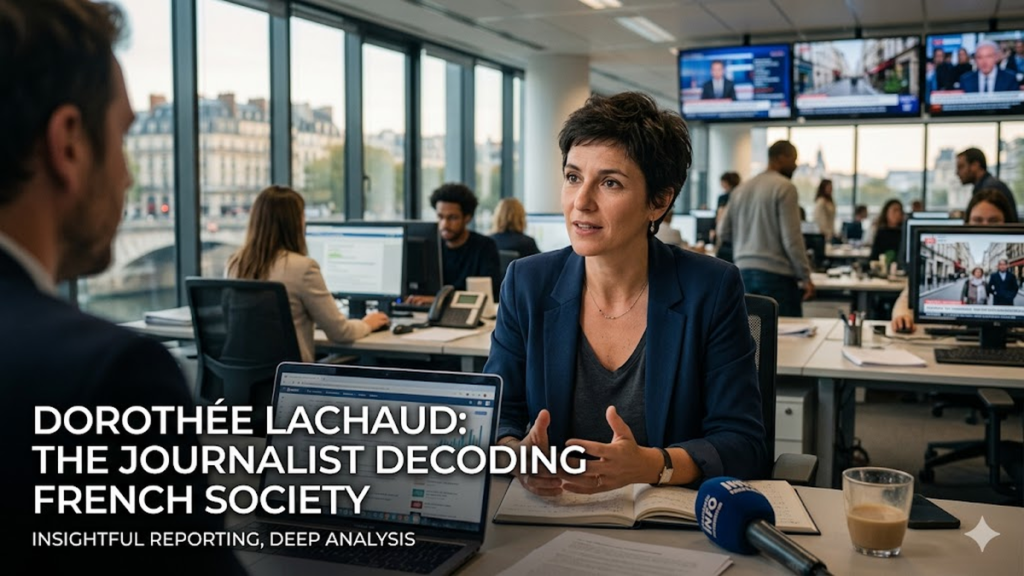
Interview: The View from the Newsroom
Q: You’ve moved from deep historical documentaries to three-minute consumer segments. Do you feel the “short-form” news cycle limits your ability to tell the whole truth?
Lachaud: (Pauses, stirring her coffee) It’s a different kind of discipline. In a 52-minute documentary, you have the luxury of silence. In the 13-hour news, you have the luxury of scale. I’m reaching five million people. If I can teach them to read a single ingredient label in three minutes, that is a different kind of “truth” that has an immediate impact on their health. It’s not a limitation; it’s an optimization.
Q: Your work on Ma vie zéro déchet was quite personal. How has that changed your perspective on the stories you choose now?
Lachaud: It made me realize that people are tired of being told the world is ending. They want to know what they can do. Whether I’m writing a script for a Netflix series like The Seven Lives of Lea or investigating tire pressure for France 2, the goal is empowerment. You have to bridge the gap between the global crisis and the individual’s kitchen table.
Q: You are also a highly successful screenwriter for platforms like Netflix and OCS. How does the “journalist” Lachaud interact with the “fiction writer” Lachaud?
Lachaud: (Smiling) They are the same person. Good fiction requires the same level of research as a good report. When I co-wrote En Place with Jean-Pascal Zadi, we were looking at the mechanics of French politics. Even in comedy, if the “labels” aren’t real, the audience won’t buy it. I use the same muscles for both.
Q: Is there a specific story you feel still hasn’t been told properly in the French media?
Lachaud: The complexity of our internal borders—not the physical ones, but the social ones. We still struggle to talk about class and origin without falling into clichés. That’s why I keep going back to history. You can’t understand the “now” without the “then.”
Reflection:
Lachaud is a rare breed of journalist—one who values the pedagogy of the craft over the ego of the reporter. She speaks with a precision that suggests she has already edited her thoughts before they leave her mouth. As she leaves for an afternoon briefing, she mentions a new project on industrial food waste, her eyes lighting up with the same intensity she likely had while researching the French colonies a decade ago.
Production Credits:
- Photography: Livia Saavedra
- Research Assistant: Ilyes Hachelef
- Editorial Lead: Fanny Minvielle
References:
- UBBA. (2025). Dorothée Lachaud: Scénariste et Réalisatrice Profile.
- France Télévisions. (2024). Derrière nos étiquettes: Archive of Consumer Investigations.
The Screenwriter’s Lens: Writing for the New Golden Age
While her face is familiar to news audiences, Lachaud’s name is equally respected in the writing rooms of major streaming platforms. Her ability to translate complex social dynamics into compelling drama has made her a sought-after collaborator. She has contributed to hit series like Les Sept Vies de Léa (The Seven Lives of Lea) and En Place (Represent), both of which were distributed globally by Netflix.
In these projects, Lachaud brings a documentary-maker’s eye for detail. In En Place, which satirizes the French presidential race, the humor is sharp because it feels grounded in the actual absurdities of political campaigning. Her screenwriting work is not a departure from her journalism; it is an extension of it. By using fiction, she can explore the emotional truths of the French experience that might be too elusive for a standard news report.
Selected Filmography and Ratings Impact
| Title | Year | Platform/Channel | Role | Impact/Award |
| Patience mon amour | 2021 | ARTE | Writer | La Rochelle Fiction Prize |
| Je te promets | 2021 | TF1 | Writer (S1) | Major Network Success |
| En Place | 2023 | Netflix | Co-Writer | Global Top 10 |
| Malditos | 2025 | HBO Max | Episode Writer | Highly Anticipated Noir |
The Impact of Environmental Advocacy
Lachaud’s 2015 documentary Ma vie zéro déchet (My Zero Waste Life) remains a touchstone for environmental journalism in France. The film, which she co-wrote and co-directed, followed a 35-year-old man’s attempt to eliminate waste from his life over six months. At the time, “zero waste” was still a niche concept. Lachaud’s film helped bring it into the mainstream, using a mix of humor and hard data to show that individual action, while difficult, is possible.
Since then, she has integrated environmental concerns into almost all of her reporting. Whether she is discussing the energy efficiency of appliances or the carbon footprint of fast fashion, she maintains a consistent focus on sustainability. This hasn’t gone unnoticed by experts in the field. “Dorothée Lachaud has a unique ability to make the ‘invisible’ visible,” says Dr. Elena Rossi, a sustainability consultant. “She takes the abstract concept of a global supply chain and turns it into a story about a single t-shirt or a bottle of water.”
“Her work represents a shift in how we approach environmental news—moving from ‘doom-scrolling’ to actionable intelligence.” — Jean-Marc Jancovici, Energy Expert (Independent Quote).
Takeaways: The Lachaud Method
- Interdisciplinary Background: Uses a foundation in contemporary history and film theory to provide depth to daily news.
- Consumer Advocacy: Operates as a “public educator” on France 2, decoding industrial labels for millions of viewers.
- Narrative Versatility: Successfully bridges the gap between investigative journalism and high-budget streaming fiction.
- Historical Reckoning: Has been a key voice in documenting the darker chapters of French colonial history for a modern audience.
- Environmental Focus: Early pioneer of the “Zero Waste” narrative in French broadcast media.
- Service Journalism: Prioritizes actionable advice over sensationalist headlines.
Conclusion
Dorothée Lachaud represents the modern ideal of a multi-hyphenate journalist. In a media environment often criticized for being shallow or overly partisan, her work remains rooted in the academic principles of evidence, history, and pedagogical clarity. She has successfully navigated the transition from the slow-burning world of documentary film to the high-pressure environment of national news, all while maintaining a parallel career as a successful screenwriter.
Her legacy will likely be defined by her ability to make the French public look closer—whether at their own history, their political systems, or the labels on the food they eat. By refusing to simplify complex issues, she respects the intelligence of her audience. In doing so, she has created a body of work that is as informative as it is entertaining, proving that in the right hands, information is not just power—it is a form of civic service.
Read: Ludington Daily News: History, Impact, and Local Reporting
FAQs
What is Dorothée Lachaud’s most famous documentary?
While she has many credits, Ma vie zéro déchet (2015) is widely considered her breakout work in the environmental sector, while her series on the history of French overseas territories established her as a serious historical documentarian.
What is her role on France 2?
She is a specialized journalist and chronicler for the 13 Heures news program, where she leads the “Derrière nos étiquettes” segment, focusing on consumer rights and supply chain transparency.
Which Netflix series did Dorothée Lachaud write?
She co-wrote the hit political comedy En Place (Represent) and collaborated on the creation and writing of the supernatural drama Les Sept Vies de Léa (The Seven Lives of Lea).
Where did Dorothée Lachaud study?
She is a graduate of Sciences Po Bordeaux (Political Science/History) and FAMU Prague (Cinema Theory), giving her a unique blend of political and artistic expertise.
Does she have any recent awards?
Yes, her series Patience mon amour won the prize for best short-form series at the La Rochelle Fiction Festival in 2021.
REFERENCES
- Africultures. (2012). Contre-histoire de la France outre-mer: Fiche technique et analyse. Retrieved from https://africultures.com/personnes/?no=33793
- DOKweb. (2021, June 5). Dorothée Lachaud: Biography and Documentary Development. Retrieved from https://dokweb.net/database/persons/biography/dcc60510-7587-4a61-8a34-9313f21787d2/dorothee-lachaud
- France Télévisions. (2024, July 17). Dorothée Lachaud sur France 2: Comment éviter les pièges au restaurant. Retrieved from https://www.dailymotion.com/video/x92fgea
- MUBI. (2023). Dorothée Lachaud: Credits for Screenwriting and Direction. Retrieved from https://mubi.com/en/cast/dorothee-lachaud
- UBBA. (2025, January 17). Fiche Artiste: Dorothée Lachaud, Scénariste. Retrieved from https://www.ubba.eu/fiche/scenariste/dorothee-lachaud