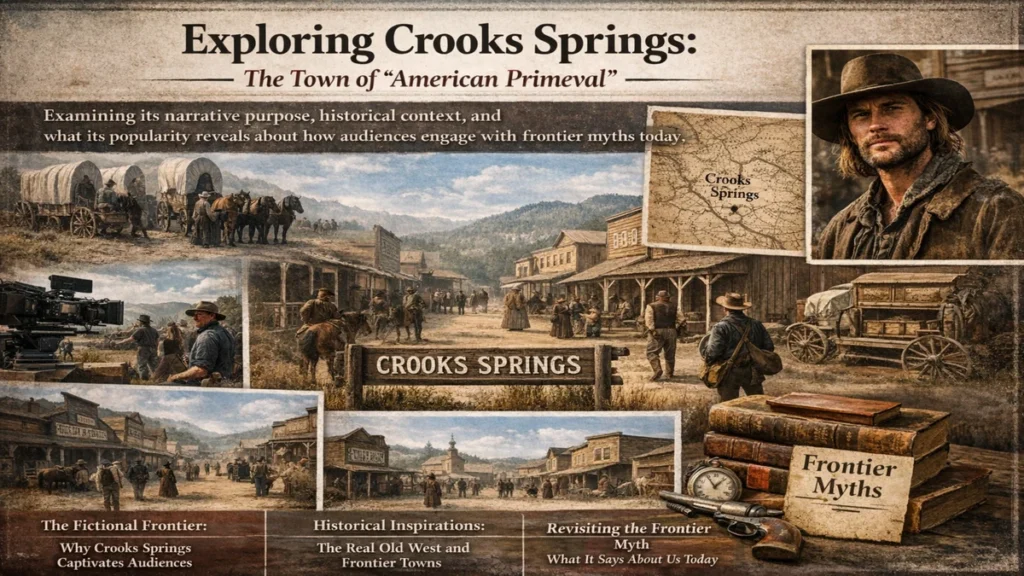
“Crooks Springs, Utah” are usually looking for a real place. They want to know where it is, whether they can visit it, and what history it has. The clear answer is that Crooks Springs is not a real town and never was. It is a fictional settlement created for the television series American Primeval, designed to function as a symbolic destination within a story set during the turbulent period of the 1857 Utah War. The town feels real because it is carefully written, visually convincing, and emotionally meaningful, but it exists only inside a narrative.
Crooks Springs is portrayed as a place of safety and reunion beyond the Wasatch Mountains, a destination that characters risk their lives to reach. In the logic of the story, it represents hope, stability, and the possibility of starting over. This symbolic function is more important than geographic accuracy. The town operates as a narrative magnet, pulling characters forward and structuring the emotional arc of the series.
Understanding Crooks Springs therefore requires reading it not as geography, but as storytelling. It is part of a long tradition in Western narratives of inventing towns that feel historically plausible in order to explore deeper human themes such as survival, belonging, conflict, and transformation. This article examines why Crooks Springs was created, what historical realities surround its fictional setting, and what its popularity says about the way modern audiences consume history through entertainment.
Crooks Springs inside the story world
Within American Primeval, Crooks Springs is not just a town but a promise. Characters speak of it as a place where violence recedes, where families can reunite, and where the chaos of the frontier gives way to something more stable. It becomes the emotional north star of the series.
This narrative role is crucial. Without Crooks Springs, the story would be a sequence of hardships with no horizon. With it, every danger gains meaning because it is endured for a reason. The town’s fictional nature allows the writers to shape it precisely to fit that function. It can be distant enough to justify peril, welcoming enough to justify hope, and vague enough to avoid historical constraints.
In this way, Crooks Springs resembles many earlier fictional towns in Western storytelling. These towns are not meant to be accurate. They are meant to be legible. They give viewers a place to emotionally orient themselves within a harsh and morally complex world.
Historical context behind the fiction
Although Crooks Springs is invented, the historical setting of American Primeval is real. The series takes place during the 1857 Utah War, a confrontation between Mormon settlers in the Utah Territory and the U.S. federal government. This period was marked by deep suspicion, militarization, and social tension.
The frontier at that time was not the romantic open space of later mythology, but a contested zone where political authority, religious autonomy, and territorial control collided. Settlers, Indigenous communities, federal troops, and migrating families all occupied overlapping and often hostile spaces.
By placing Crooks Springs within this historical moment, the series uses a real conflict as emotional and narrative soil. The invented town grows out of that soil as a symbolic answer to instability. It becomes a counterweight to the chaos of the era, even though it never existed within it.
Why fictional towns feel real
Crooks Springs feels real for three reasons. First, it is embedded in a carefully researched historical atmosphere. Costumes, language, and conflicts all reference genuine nineteenth-century conditions. Second, it is filmed in landscapes that match the audience’s mental image of the American West, even if those landscapes are geographically elsewhere. Third, it is emotionally consistent. Characters treat it as real, speak of it with longing, and shape their decisions around it.
Reality in narrative is not about factual existence. It is about internal coherence. Crooks Springs has that coherence, and so viewers accept it.
This phenomenon reveals how cultural memory works. We often remember the emotional truth of stories more than their factual content. Over time, invented places can feel as familiar as real ones because they occupy the same mental and emotional space.
Filming and visual construction
Although the story places Crooks Springs in Utah, the physical scenes were filmed in other Western landscapes chosen for their visual similarity to frontier imagery. These locations provide mountains, plains, and skies that match the aesthetic language of Western storytelling.
The camera does much of the work in making Crooks Springs feel plausible. Long shots emphasize isolation and distance. Warm light suggests safety and refuge. The town is visually coded as a contrast to danger, even when danger intrudes.
This visual grammar teaches viewers how to feel about the place before they think about it. By the time a viewer wonders whether Crooks Springs is real, it already feels emotionally real.
Fiction as a tool for historical engagement
Invented places like Crooks Springs allow storytellers to explore historical themes without being bound by the specific constraints of real locations. This gives them freedom to combine events, characters, and timelines in ways that highlight meaning rather than accuracy.
This does not mean such stories are dishonest. They are interpretive. They use fiction to illuminate patterns that might otherwise be obscured by detail. Crooks Springs becomes a vessel for questions about migration, hope, fear, and moral compromise.
Through this lens, the town is not a mistake or a trick. It is a narrative instrument.
Comparison with other fictional frontier towns
| Town | Source | Narrative purpose |
|---|---|---|
| Crooks Springs | American Primeval | Hope and destination |
| Lonesome Dove | Novel and series | Reflection and aging |
| Deadwood | Television series | Social order from chaos |
| Dodge City | Western television | Law and justice |
| Feature | Real towns | Fictional towns |
|---|---|---|
| Historical accuracy | High | Flexible |
| Symbolic clarity | Limited | High |
| Narrative adaptability | Low | High |
| Emotional design | Emergent | Intentional |
These comparisons show why fiction often outperforms reality in storytelling. It can be shaped to serve meaning.
Expert perspectives
Cultural historians argue that frontier mythology has always been partly fictional, even when based on real events. The frontier is less a place than a story Americans tell about themselves.
Media theorists note that modern audiences engage with history primarily through narrative media rather than academic texts. Fiction becomes the gateway to historical interest.
Psychologists studying narrative immersion observe that people process fictional environments using the same cognitive mechanisms as real ones. Emotional investment does not depend on factual existence.
These perspectives help explain why Crooks Springs matters even though it is not real.
Cultural impact and audience response
The popularity of Crooks Springs as a search term shows that audiences want to connect fiction back to reality. They want to know where a story fits into the world they know.
This impulse is healthy. It reflects curiosity and a desire for understanding. But it also reveals how easily narrative can reshape perception. When fiction feels authentic, it invites people to treat it as history.
This is not a failure of the audience. It is a testament to the power of storytelling.
Takeaways
- Crooks Springs is fictional, not historical.
- It exists to serve narrative and emotional purposes.
- It is embedded in a real historical context for credibility.
- Visual storytelling makes it feel geographically real.
- Fictional places often communicate meaning more clearly than real ones.
- Audience curiosity reflects narrative success.
- Storytelling shapes cultural memory.
Conclusion
Crooks Springs, Utah, does not exist on any map, but it exists in the cultural imagination. It represents a longing for safety, for home, for resolution in a world defined by conflict. Its power lies not in its factual reality but in its emotional truth.
The town reminds us that history is not only what happened, but how we remember, interpret, and feel about what happened. Fiction becomes the bridge between past and present, between data and meaning.
In this sense, Crooks Springs is not a false place. It is a symbolic one. It shows how modern storytelling continues an ancient human practice: using imagined spaces to make sense of real experiences.
FAQs
Is Crooks Springs a real town in Utah?
No. It is a fictional town created for a television series.
Why did the writers invent it?
To create a symbolic destination that structures the story emotionally.
Is the historical background real?
Yes. The Utah War and frontier tensions are real historical events.
Where was it filmed?
In Western landscapes chosen to resemble frontier settings, not in Utah itself.
Why does it feel so real?
Because narrative coherence and emotional investment create a sense of reality.