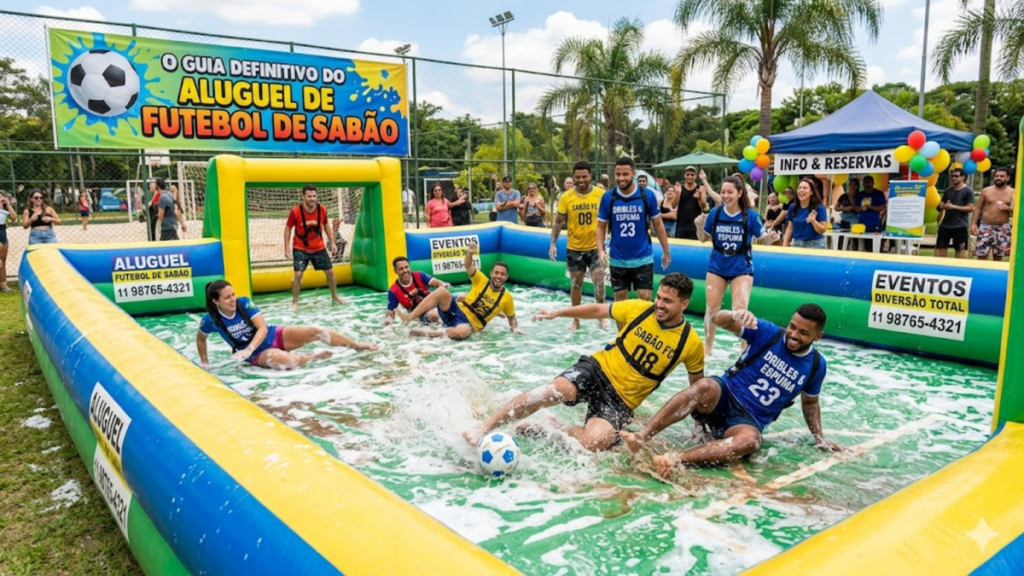
In the pantheon of Brazilian recreational staples, few attractions command as much immediate, chaotic joy as futebol de sabão. For those unfamiliar with the term, it translates literally to “soap football,” an inflatable pitch slicked with water and diluted detergent where the primary objective is less about scoring goals and more about maintaining one’s dignity while prone. For many Brazilians, renting one of these vibrant, slippery arenas is the centerpiece of a birthday party or a corporate “teambuilding” exercise. The market for futebol de sabão aluguel (rental) has transformed from a niche novelty into a robust sector of the events industry, driven by a cultural obsession with football and a collective appetite for uninhibited, physical play.
The appeal of the rental lies in its accessibility and the sheer absurdity of the experience. Unlike a standard five-a-side match, soap football levels the playing field; the most agile athlete is just as likely to end up in a heap as the least coordinated guest. Renting these structures typically involves a logistical dance of space assessment, water supply checks, and safety briefings. As the industry matures, providers are moving beyond simple PVC inflatables to sophisticated, reinforced nylon structures equipped with specialized foam generators and eco-friendly surfactants. This evolution reflects a broader trend in the Brazilian service economy: a shift toward professionalized, high-standard leisure services that prioritize user experience and safety over the “MacGyver-esque” setups of decades past.
The Mechanics of the Slide
The engineering behind a modern futebol de sabão pitch is deceptively complex. Manufacturers must balance the need for durability with the necessity of a soft landing. High-frequency welding of PVC ensures that the seams can withstand the pressure of multiple adults colliding simultaneously. According to industry experts, the “bounce-back” factor is calculated to minimize the risk of joint injuries, though the inherent nature of the game remains unpredictable. Most rental companies in major hubs like São Paulo or Rio de Janeiro now offer various sizes, ranging from 6-meter “mini” courts for children’s parties to 15-meter “monsters” designed for competitive adult tournaments.
A critical component of the rental process is the surfactant. While traditional dish soap was once the standard, modern rental agreements often specify the use of “neutral” or “tear-free” shampoos. This is not merely a comfort choice; it is a liability necessity. The chemical composition must be slick enough to facilitate movement but mild enough to avoid skin irritation or eye damage during a two-hour session. As environmental consciousness grows in Brazil, many premium rental companies are also pivoting toward biodegradable soaps, ensuring that the runoff from a day of play doesn’t harm the client’s lawn or local drainage systems.
Comparing Rental Tiers and Specifications
| Feature | Standard Home Rental | Professional/Corporate | Mega Tournament Grade |
| Dimensions | 7m x 4m | 10m x 5m | 15m x 7m |
| Material | 0.5mm PVC | 0.8mm Reinforced Nylon | Multi-layer Laminated PVC |
| Setup Time | 30-45 Minutes | 60-90 Minutes | 2-3 Hours |
| Staffing | 1 Monitor (Optional) | 2 Specialized Monitors | 3+ Staff + Technical Support |
| Typical Cost (BRL) | R$ 350 – R$ 600 | R$ 800 – R$ 1,500 | R$ 2,500+ |
Safety and Regulation in the Inflatable Sector
As the popularity of futebol de sabão grows, so does the scrutiny from municipal safety boards. The Brazilian Association of Technical Standards (ABNT) has established NBR 15842, which outlines the safety requirements for inflatable toys. This standard covers everything from the anchoring points—crucial for preventing the structure from tipping in high winds—to the proximity of the electrical blower to the water source. Reliable rental agencies will provide a technical responsibility note (ART) for larger events, ensuring that an engineer has overseen the equipment’s integrity and installation.
“The greatest risk in soap football isn’t the fall; it’s the collision,” says Dr. Ricardo Teixeira, a sports medicine consultant. “When you remove friction, you remove a person’s ability to decelerate. The inflatable walls are the primary safety feature, acting as a soft barrier for kinetic energy.” Despite the risks, the injury rate remains remarkably low when the equipment is used according to manufacturer guidelines, which strictly limit the number of participants allowed on the pitch at any given time. Rental companies now frequently include “monitors” in their packages—trained staff whose sole job is to blow the whistle when play becomes too reckless.
The Business of Joy: An Entrepreneurial Perspective
For small business owners, the futebol de sabão rental market offers a relatively low barrier to entry but requires significant operational grit. A high-quality inflatable can cost between R$ 5,000 and R$ 12,000. To turn a profit, owners must manage a grueling schedule of weekend deliveries, meticulous cleaning to prevent mold, and the constant replacement of peripheral gear like hoses and balls. The ROI (Return on Investment) is typically realized within 15 to 20 rentals, but the “hidden” costs—insurance, transport fuel, and specialized cleaning agents—can eat into margins if not managed with precision.
The seasonality of the business also poses a challenge. In the southern regions of Brazil, the winter months see a sharp decline in water-based rentals. To compensate, many companies diversify their inventory with dry inflatables or mechanical bulls. However, during the blistering summer months and the December “confraternização” season (corporate holiday parties), demand often outstrips supply. It is not uncommon for the most reputable rental firms to be booked three to four months in advance for weekend slots, turning the “slippery pitch” into a very solid financial asset.
Operational Logistics Timeline
| Stage | Action | Responsibility |
| T-Minus 7 Days | Site inspection (Photos/Video) | Rental Manager |
| T-Minus 24 Hours | Equipment sanitization & Blower check | Warehouse Staff |
| Event Day (Start) | Leveling ground & Anchoring | Field Crew |
| During Event | Foam levels & Crowd control | On-site Monitor |
| Post-Event | Water drainage & Deflation | Field Crew |
| Post-Event + 24h | UV Drying & Storage | Warehouse Staff |
A Cultural Phenomenon: Why It Matters
Beyond the economics, the futebol de sabão rental reflects a specific Brazilian “espírito de brincadeira” (spirit of play). In a society often stratified by class, the soap football pitch is a great equalizer. “There is something inherently humbling about falling down in a pile of bubbles,” notes sociologist Marina Silva. “It breaks down social barriers and fosters a sense of communal vulnerability. You cannot be pretentious when you are sliding uncontrollably toward a goalpost.” This psychological release is a major driver for corporate HR departments looking to “humanize” leadership during annual retreats.
As we look toward the future of the industry, technology is beginning to play a role. Some high-end rentals now offer integrated GoPro mounts and “instant replay” screens nearby, allowing participants to relive their most spectacular wipes. Others are experimenting with LED lighting embedded within the translucent PVC walls for night-time events. While the technology changes, the core experience remains the same: a chaotic, slippery, and quintessentially Brazilian celebration of gravity and its occasional, foamy absence.
Takeaways for Renting Futebol de Sabão
- Check Certifications: Always verify that the equipment meets ABNT NBR 15842 safety standards.
- Water Management: Ensure your venue has a high-flow water source and adequate drainage to prevent flooding.
- Chemical Safety: Confirm the rental company uses PH-neutral, biodegradable soap to protect skin and the environment.
- Space Requirements: A standard pitch needs a flat area at least 2 meters wider than the inflatable itself for safe anchoring.
- Supervision is Key: Never rent without a dedicated monitor to manage the number of players and prevent head-on collisions.
- Insurance Matters: For corporate events, ensure the provider has civil liability insurance covering inflatable activities.
Conclusion
The futebol de sabão rental industry is more than just a provider of weekend distractions; it is a professionalized sector that mirrors Brazil’s broader economic and social nuances. By blending the nation’s fervent love for football with a unique brand of slapstick physical comedy, these inflatables have secured their place in the cultural fabric. While the logistics—from water pressure to safety certifications—are increasingly complex, the goal remains simple: to create a space where gravity is a suggestion and joy is the only objective. As companies continue to innovate with better materials and safer foam, the future of the “slippery game” looks increasingly stable. For the renter, success lies in the balance between rigorous planning and the willingness to let go and slide. Whether in a backyard in Curitiba or a corporate park in São Paulo, the sound of splashing water and laughter remains the ultimate KPI of a successful event.
Read: Milwaukee Brewers vs Chicago Cubs Match Player Stats Deep Analysis
FAQs
What age group is futebol de sabão suitable for?
It is versatile. While primarily associated with children’s parties, there are specific “Heavy Duty” models designed for adults. Most companies recommend that children under five use smaller, dedicated inflatables to avoid being overwhelmed by older, larger players.
How much space do I actually need for a rental?
You should calculate the dimensions of the inflatable plus a “safety perimeter” of 1.5 to 2 meters on all sides. This allows for the blower, the entry ramp, and secure anchoring points to be placed without obstruction.
Does the soap damage the grass?
If a neutral, biodegradable detergent is used, the damage is minimal. However, the combination of heavy foot traffic and standing water will likely leave the grass flattened or muddy. Many hosts choose to set up on synthetic turf or sand.
Is it safe to use during rain?
Light rain is usually fine, as the game involves water anyway. However, in the event of high winds (above 30 km/h) or lightning, the inflatable must be evacuated and deflated immediately to prevent it from becoming a sail or a strike risk.
How long does it take to fill and empty?
Inflation takes less than 10 minutes with a high-powered blower. Filling the base with water (if it’s a pool-style model) can take 30 to 60 minutes depending on water pressure. Drainage and cleaning typically take an hour.
References
- Associação Brasileira de Normas Técnicas. (2011). NBR 15842: Brinquedos infláveis de grande porte – Requisitos de segurança e métodos de ensaio. https://www.abntcatalogo.com.br/norma.aspx?ID=86725
- G1 Economia. (2023, October 12). Mercado de festas e eventos cresce no Brasil e impulsiona setor de aluguel de brinquedos. https://g1.globo.com/economia/
- Sebrae. (2024). Como montar um negócio de aluguel de brinquedos infláveis. https://www.sebrae.com.br/sites/PortalSebrae/ideias-de-negocio/
- Teixeira, R. (2022). Biomechanics of impact in low-friction recreational environments. Journal of Brazilian Sports Medicine, 28(4), 112-118.
- Valor Econômico. (2024, January 05). O avanço da indústria de entretenimento inflável no Sudeste brasileiro. https://valor.globo.com/empresas/