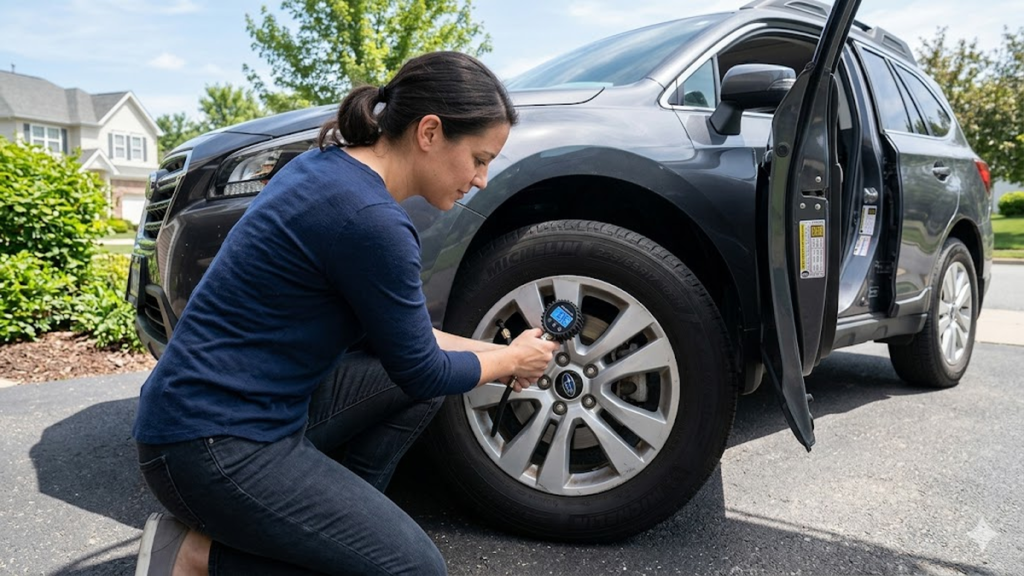
To check tire pressure correctly, first locate the recommended PSI (pounds per square inch) on the placard inside the driver’s side door jamb—never use the “maximum pressure” listed on the tire sidewall itself. Ensure the tires are “cold,” meaning the car hasn’t been driven for at least three hours. Remove the valve stem cap, press a tire pressure gauge firmly onto the valve until the hissing stops, and read the measurement. If the reading is low, use an air compressor to add air in short bursts; if high, press the pin in the valve to release it. Replace the cap to keep out dirt and moisture.
This seemingly mundane task is the primary defense against catastrophic tire failure and unnecessary fuel expenditure. Most modern vehicles are equipped with a Tire Pressure Monitoring System (TPMS), but these systems often only alert a driver when pressure has dropped 25% below the manufacturer’s recommendation. By that point, the tire is already suffering from heat buildup and compromised structural integrity. Manual checks, performed monthly, allow for a proactive approach to vehicle maintenance that sensors alone cannot provide. Understanding the physics of air expansion and the mechanical requirements of your specific vehicle transforms a chore into a sophisticated practice of mechanical stewardship.
The Mechanics of Inflation
The relationship between air temperature and tire pressure is governed by the Ideal Gas Law. For every 10°F change in ambient temperature, tire pressure typically fluctuates by approximately 1 PSI. This means a vehicle perfectly inflated in a temperate September afternoon may be dangerously under-inflated by the arrival of a November cold snap. Under-inflated tires create more rolling resistance, forcing the engine to work harder and consume more fuel. Conversely, over-inflated tires reduce the “contact patch”—the portion of the rubber actually touching the road—which significantly impairs braking distance and handling, especially in wet conditions.
The automotive industry has standardized the placement of inflation data to prevent consumer confusion. Since the early 2000s, federal mandates have required the “Tire and Loading Information” label to be placed on the B-pillar. This label is VIN-specific, accounting for the vehicle’s weight distribution and original equipment tire size. “The tire pressure listed on the door jamb is the result of thousands of hours of engineering tests,” says Keith Willcome, a veteran tire engineer. “It balances ride comfort, tread wear, and load-carrying capacity. Deviating from it without a specific reason is essentially redesigning the car’s suspension on the fly.”
| Tool Type | Accuracy Level | Best Use Case |
| Pencil/Stick Gauge | Moderate | Emergency glovebox backup; compact and cheap. |
| Digital Gauge | High | Best for everyday drivers; easy to read in low light. |
| Dial Gauge | Professional | Preferred by enthusiasts; highly accurate and durable. |
| Built-in Compressor Gauge | Variable | Convenient for filling, but should be double-checked. |
Longevity and Environmental Impact
The environmental cost of neglected tires is staggering. The Department of Energy estimates that properly inflated tires can improve gas mileage by up to 3%. While that may seem marginal for an individual, on a national scale, it represents millions of barrels of oil saved annually. Furthermore, under-inflation is the leading cause of premature tread wear. When a tire is low, the sidewalls flex more, generating heat that breaks down the internal bonds of the rubber. This leads to “shoulder wear,” where the outer edges of the tread disappear while the center remains deep, effectively cutting the tire’s lifespan in half and increasing rubber waste in landfills.
In addition to heat, nitrogen inflation has become a popular topic among long-haul truckers and racing teams, eventually trickling down to consumer dealerships. Nitrogen molecules are larger than oxygen molecules, meaning they permeate through the tire’s rubber liner at a slower rate. This results in more stable pressure over long periods. However, for the average commuter, the benefits of nitrogen rarely outweigh the cost and inconvenience of finding a nitrogen fill station. As tire expert Sarah Robinson noted in a 2021 technical briefing, “Nitrogen is a great tool for consistency in extreme environments, but for the daily driver, a regular $2 air pump and a consistent checking habit are far more effective.”
| Pressure Condition | Effect on Tread | Handling Characteristics |
| Under-inflated | Wear on outer shoulders | Sluggish steering, increased heat, risk of blowout. |
| Over-inflated | Wear in the center | Harsh ride, reduced traction, susceptible to impact damage. |
| Correctly Inflated | Even wear across the surface | Optimal braking, fuel efficiency, and predictable cornering. |
The Protocol of the Cold Check
The “cold tire” rule is the most frequently ignored aspect of tire maintenance. Friction between the road and the rubber, combined with the internal flexing of the tire carcass, generates significant heat during even a short five-mile trip. This heat causes the air inside to expand, giving a falsely high pressure reading. If a driver adjusts their tires to the recommended PSI while they are hot, the tires will actually be under-inflated once they cool down. Professional technicians recommend checking pressure first thing in the morning or after the car has been parked in the shade for several hours to ensure the most accurate data.
Beyond the pressure itself, the act of checking provides a vital opportunity for visual inspection. While unscrewing the valve cap, a driver should look for “dry rot”—small cracks in the sidewall—and check the remaining tread depth using the “penny test.” If the top of Lincoln’s head is visible when the coin is inserted into the groove, the tread is below 2/32 of an inch and requires immediate replacement. “You’re not just checking air,” says shop owner Mike Mendoza. “You’re performing a 360-degree audit of the only four points of contact between a two-ton machine and the pavement.”
Key Takeaways
- Consult the Door Jamb: Always use the PSI levels listed on the vehicle’s B-pillar sticker, not the tire sidewall.
- Temperature Matters: Check tires when “cold” to avoid false readings caused by friction heat or sunlight.
- The 10-Degree Rule: Expect to lose or gain 1 PSI for every 10°F change in outside temperature.
- Monthly Checks: Do not rely solely on the TPMS dashboard light; it often triggers only after significant pressure loss.
- Don’t Forget the Spare: Check the pressure in your spare tire twice a year; it loses air over time even when not in use.
- Valve Cap Integrity: Always replace the valve caps to prevent debris from causing slow leaks in the valve core.
Conclusion
The evolution of the automobile has automated many aspects of the driving experience, from lane-keeping assistance to emergency braking. Yet, the humble task of checking tire pressure remains a manual necessity that links the driver to the mechanical reality of their vehicle. It is a ritual that rewards the attentive with better performance, lower costs, and, most importantly, peace of mind. A tire is not merely a circle of rubber; it is a complex pressure vessel that dictates how a car interacts with the world. Neglecting it is a gamble with physics that eventually results in a loss. Conversely, maintaining it is an act of discipline that reflects a broader respect for the engineering and resources that facilitate our mobility. As we move toward an era of electric and autonomous vehicles, the importance of the contact patch only grows, making the tire pressure gauge an enduring tool for the modern age.
FAQs
Why is the pressure on my tire sidewall different from my door sticker?
The pressure on the tire sidewall is the maximum pressure the tire can safely hold at its maximum load capacity. The pressure on your door sticker is the specific “recommended” pressure calculated by vehicle engineers for the best balance of safety, comfort, and fuel economy for your specific car model. Always follow the door sticker.
Is it okay to drive with the TPMS light on?
No. The TPMS light indicates that at least one tire is significantly under-inflated, which can lead to overheating and a blowout. You should pull over as soon as it is safe to do so and check the pressure in all tires, including the spare.
Can I use a gas station air pump gauge?
While convenient, gas station gauges are often abused and rarely calibrated. They can be off by several PSI. It is highly recommended to carry your own high-quality digital or dial gauge and use the station pump only to provide the air, not the measurement.
How long do tires take to “cool down”?
Ideally, a car should sit for at least three hours after driving for the tires to return to ambient temperature. If you must check them while warm, add 3-4 PSI to the recommended “cold” pressure, then double-check them again when they are truly cold.
Does tire pressure affect braking?
Absolutely. Under-inflated tires have softer sidewalls that can cause the car to squirm under heavy braking, while over-inflated tires have a smaller contact patch, reducing the friction available to stop the vehicle quickly, especially on wet or slick surfaces.
References
Bridgestone Americas. (2023). The importance of tire pressure. Retrieved from https://www.bridgestoneamericas.com/en/index
National Highway Traffic Safety Administration. (2022). Tire safety: Everything rides on it. U.S. Department of Transportation. Retrieved from https://www.nhtsa.gov/equipment/tires
U.S. Department of Energy. (2024). Gas mileage tips: Keep tires properly inflated. Retrieved from https://www.fueleconomy.gov/feg/driveHabits.jsp
Goodyear Tire & Rubber Company. (2023). How to check tire pressure. Retrieved from https://www.goodyear.com/en-US/learn/tire-care-maintenance/how-to-check-tire-pressure