
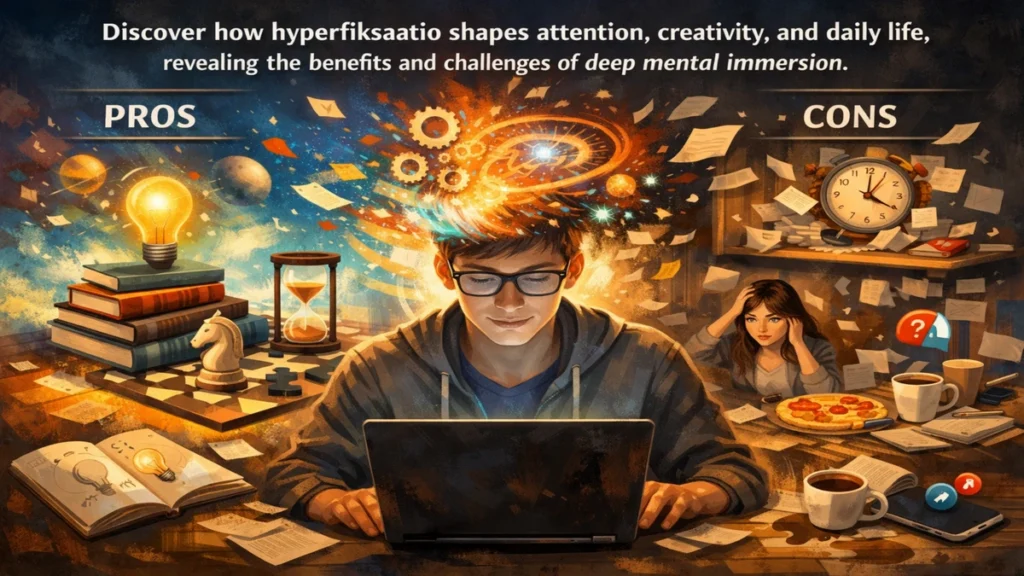
Hyperfiksaatio is the experience of becoming so deeply absorbed in a topic, activity, or idea that the rest of the world fades into the background. Time passes unnoticed, external demands feel distant, and attention narrows into a single channel of thought. For many people, this state feels energizing and meaningful; for others, it becomes disruptive, making it difficult to shift focus or attend to everyday responsibilities. The word itself, drawn from Nordic language roots and aligned with the English term “hyperfixation,” captures a psychological reality that countless people recognize but few have language for.
In the first moments of encountering the concept, readers usually want to know what hyperfiksaatio is, why it happens, and whether it is healthy or harmful. The short answer is that hyperfiksaatio is neither a diagnosis nor a disorder, but a pattern of attention. It is especially common among neurodivergent individuals, including those with ADHD or autism, yet it can appear in anyone under the right emotional, cognitive, or motivational conditions. Understanding it requires looking at how the brain allocates attention, how reward systems guide motivation, and how personal meaning shapes what captures the mind.
This article explores hyperfiksaatio as a psychological state, a lived experience, and a cultural phenomenon. It examines how it arises, how it feels, how it affects work, learning, and relationships, and how people can live with it in balanced and healthy ways. Rather than framing hyperfiksaatio as a problem to be solved, this piece treats it as a window into how human attention works at its most intense.
Understanding Hyperfiksaatio
Hyperfiksaatio refers to a state of extreme focus in which a person becomes mentally absorbed in a single subject or activity to the exclusion of most other stimuli. Unlike ordinary concentration, which is usually purposeful and bounded by time or task, hyperfiksaatio often feels involuntary and self-reinforcing. The mind returns again and again to the same topic, even when the person intends to shift attention elsewhere.
People experiencing hyperfiksaatio often describe losing track of time, forgetting basic needs like hunger or sleep, and feeling resistant or distressed when interrupted. This is not because they lack self-control, but because the brain’s attention and reward systems are strongly engaged with the chosen focus. The experience can feel like being carried by a current rather than swimming deliberately.
Importantly, hyperfiksaatio is not inherently negative. It can support deep learning, creativity, mastery, and emotional satisfaction. Many people attribute their greatest achievements or joys to periods of intense focus. Problems arise only when hyperfiksaatio becomes rigid, prolonged, or misaligned with a person’s broader goals and needs.
Historical and Scientific Context
Psychology has long studied attention, but only relatively recently has it emphasized how uneven and context-dependent attention can be. Early models treated attention as a limited resource to be allocated rationally. Later research revealed that attention is deeply shaped by emotion, motivation, novelty, and reward.
Neuroscientifically, intense focus is linked to the brain’s dopamine systems, which signal reward, salience, and motivation. When something feels highly meaningful, stimulating, or emotionally charged, dopamine activity increases, reinforcing attention toward that stimulus. In hyperfiksaatio, this reinforcement loop becomes particularly strong, making disengagement difficult even when the person wants to stop.
This understanding reframes hyperfiksaatio not as a failure of control but as a success of motivation. The brain is doing what it evolved to do: prioritize what seems most important or rewarding. The challenge in modern life is that what feels rewarding is not always what is socially, professionally, or personally optimal in the long term.
Read: How to Avoid Dry Socket After Tooth Extraction
Hyperfiksaatio and Neurodivergence
Hyperfiksaatio is especially visible in neurodivergent communities, particularly among people with ADHD and autism. In ADHD, attention regulation is less about an inability to focus and more about difficulty controlling what the mind focuses on. Highly stimulating or emotionally engaging tasks can draw attention powerfully, while mundane tasks struggle to compete.
In autism, intense and enduring interests often play a central role in identity, learning, and comfort. These interests can resemble hyperfiksaatio, but they tend to be more stable over time and less disruptive, often serving as sources of joy, expertise, and emotional regulation.
Recognizing these patterns is important because it shifts the narrative from pathology to difference. Hyperfiksaatio is not a symptom to eliminate but a cognitive style to understand and integrate into a person’s life in supportive ways.
The Lived Experience of Hyperfiksaatio
Subjectively, hyperfiksaatio can feel like falling in love with an idea. There is excitement, clarity, and a sense of purpose. The mind feels alive and engaged, and the world feels coherent around a central theme.
At the same time, people may feel trapped by their own focus. They may intend to do something else but find themselves returning to the same topic again and again. Interruptions can feel jarring or even painful, like being pulled out of a vivid dream.
These mixed feelings explain why hyperfiksaatio is often described with both affection and frustration. It is a source of depth and meaning, but also of imbalance.
Expert Perspectives
One cognitive scientist describes hyperfiksaatio as “attention driven by intrinsic reward rather than external demand.” A neurodiversity advocate frames it as “the mind’s way of telling us what matters most to us, even when society disagrees.” A clinical therapist emphasizes that “the goal is not to suppress hyperfiksaatio but to build structures around it that protect health, relationships, and responsibility.”
These perspectives converge on a single idea: hyperfiksaatio is not an enemy of wellbeing, but a force that must be understood and guided.
Hyperfiksaatio in Work and Learning
In professional and academic settings, hyperfiksaatio can be a powerful asset. It supports deep work, complex problem solving, and creative breakthroughs. Many innovations arise from people who became intensely absorbed in a question or craft.
However, modern workplaces often demand multitasking, rapid switching, and responsiveness. These demands clash with the nature of hyperfiksaatio, which resists fragmentation. Without accommodation, individuals may be misunderstood as unresponsive, obsessive, or inflexible when they are simply deeply engaged.
Educational systems face similar challenges. Students who hyperfixate may excel in some areas and struggle in others, not because of ability but because of how attention is distributed. Supportive environments that allow depth alongside breadth can help harness this cognitive style.
Hyperfiksaatio in Relationships
In relationships, hyperfiksaatio can be both bonding and distancing. Sharing a deep interest can create intimacy and connection. But when one person’s focus consistently overshadows shared time or emotional presence, partners may feel neglected.
Communication is key. Explaining hyperfiksaatio to loved ones helps transform misunderstanding into empathy. Setting boundaries and intentional times for connection allows relationships to coexist with intense focus rather than compete with it.
Cultural and Social Meanings
Culturally, societies send mixed messages about intense focus. Passion, dedication, and expertise are praised, but obsession and imbalance are criticized. Hyperfiksaatio sits uneasily between these values.
Understanding hyperfiksaatio challenges simplistic moral judgments about attention. It asks us to recognize that not all minds are built for the same rhythms of focus and rest, and that diversity in attention styles enriches collective creativity and knowledge.
Takeaways
- Hyperfiksaatio is an intense, immersive state of focus driven by emotional and motivational engagement.
- It is common in neurodivergent experiences but can occur in anyone.
- It can support learning, creativity, and meaning, while also risking imbalance if unmanaged.
- Understanding and accommodation are more helpful than suppression.
- Balance comes from structure, communication, and self-awareness.
Conclusion
Hyperfiksaatio reveals something profound about the human mind: our attention is not neutral or mechanical, but emotional, meaningful, and deeply personal. What we focus on is not random; it reflects what we care about, what stimulates us, and what gives us a sense of purpose.
Rather than treating hyperfiksaatio as a problem to fix, we can treat it as a signal to listen to. When guided with awareness and supported by structure, it becomes a source of depth rather than distortion. It reminds us that attention is not just a tool for productivity, but a lens through which we experience life itself.
FAQs
What is hyperfiksaatio?
It is a state of intense, prolonged mental focus on a topic or activity, often to the exclusion of other concerns.
Is hyperfiksaatio a disorder?
No. It is a pattern of attention, not a diagnosis, though it is common in neurodivergent individuals.
Can hyperfiksaatio be beneficial?
Yes. It can support deep learning, creativity, and satisfaction when aligned with personal and practical goals.
Can it be harmful?
It can become problematic if it consistently interferes with health, responsibilities, or relationships.
How can someone manage hyperfiksaatio?
Through self-awareness, time boundaries, external reminders, and supportive communication with others.
REFERENCES
- Add.org. (2025). ADHD & hyperfixation: The phenomenon of extreme focus. Retrieved from https://add.org/adhd-hyperfixation/ ADDA
- Charlie Health. (2023). Is it hyperfixation or just a new obsession? Retrieved from https://www.charliehealth.com/post/what-is-hyperfixation Charlie Health
- Sandstone Care. (2025). Hyperfixation: What it is and how to combat hyperfocusing. Retrieved from https://www.sandstonecare.com/blog/hyperfixation/ Sandstone Care
- Top Hat. (n.d.). Hyperfixation definition and meaning. Retrieved from https://tophat.com/glossary/h/hyperfixation/ Top Hat
- Healthline. (2023). Special interest vs. hyperfixation: Differences and resources. Retrieved from https://www.healthline.com/health/mental-health/special-interest-vs-hyperfixation