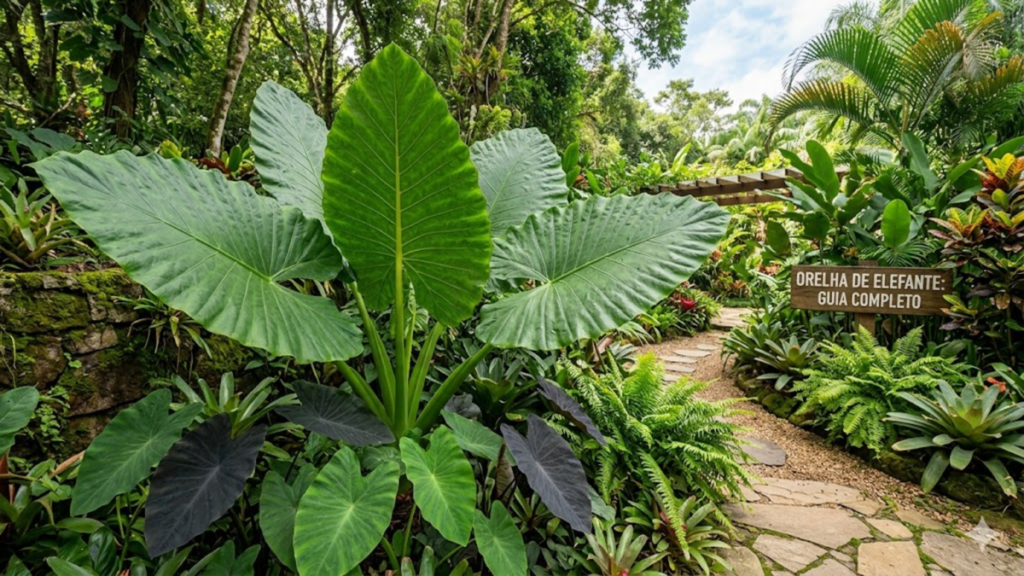
The orelha de elefante, commonly known in the English-speaking world as the “elephant ear,” is not a single entity but a broad horticultural classification encompassing some of the most dramatic foliage in the plant kingdom. Predominantly representing the genera Alocasia, Colocasia, and Xanthosoma, these plants are defined by their massive, heart-shaped leaves that can reach up to three feet in length. For the modern enthusiast, they represent the ultimate “statement plant,” a piece of living architecture capable of transforming a sterile indoor space into a lush, prehistoric-looking sanctuary. Yet, behind their aesthetic appeal lies a deep evolutionary history rooted in the humid understories of the Indo-Malayan region and the Caribbean.
Understanding the orelha de elefante requires a journey through both botany and anthropology. While they are prized today for the metallic sheen of a “Red Secret” or the stark white veins of a “Frydek,” these plants served as vital starch sources for Austronesian settlers and Caribbean indigenous groups for millennia. They are survivors of the rainforest floor, having evolved specialized mechanisms like guttation—the secretion of water droplets—to handle the intense humidity of their native habitats. As they migrate into the global domestic market, the challenge for the modern gardener is to replicate these complex tropical conditions within the dry, static confines of a four-walled home.
The Taxonomy of Giants: A Comparative Analysis
Distinguishing between the various species of elephant ears is a common point of confusion for novice collectors. While they share the “orelha de elefante” moniker, their growth habits and physiological needs vary significantly. The Alocasia genus, for instance, typically holds its leaves upright, pointing toward the sky, while the Colocasia tends to have drooping leaves that point toward the earth. This distinction is more than aesthetic; it reflects their evolutionary adaptation to light and water runoff in different tropical niches.
| Feature | Alocasia (Giant Taro) | Colocasia (Taro) | Xanthosoma (Malanga) |
| Leaf Orientation | Upward / Horizontal | Downward-pointing | Downward-pointing |
| Petiole Attachment | At the leaf notch | Peltate (center of leaf) | At the leaf notch |
| Preferred Light | Bright, Indirect | Full Sun to Part Shade | Part Shade |
| Water Needs | Well-drained, moist | High (can be aquatic) | Well-drained |
| Native Region | Southeast Asia / Australia | Asia-Pacific | Tropical Americas |
Beyond these three, the Xanthosoma provides a New World perspective on the elephant ear. Native to the tropical Americas, it is often confused with its Asian cousins but can be identified by its distinctive “collecting vein” that runs along the very edge of the leaf margin. These subtle morphological differences are the result of millions of years of geographic isolation, yet in the globalized nursery trade, they sit side-by-side, often labeled simply by their common Portuguese or English names.
From Sustenance to Style: A Cultural History
The history of the Alocasia macrorrhizos, arguably the most iconic orelha de elefante, is inextricably linked to the history of human migration. Archaeobotanical evidence suggests that these plants were domesticated in the Philippines tens of thousands of years ago. As Austronesian peoples navigated the Pacific, they carried corms of elephant ears as “canoe plants,” ensuring a reliable source of carbohydrates in new territories. In Hawaii, the plant known as ‘ape served as a secondary food source, though its high concentration of calcium oxalate crystals—which cause an intense stinging sensation if not cooked properly—led to the proverb, “The eater of ‘ape will have an itchy mouth.”
In the 19th century, the plant underwent a radical shift in identity. European botanists and explorers, captivated by the “exotic” and “monstrous” scale of the foliage, began transporting specimens back to Victorian glasshouses. Here, the elephant ear was stripped of its status as a staple crop and reborn as a symbol of colonial botanical conquest and luxury. This transition from the “peasant’s pot” to the “collector’s conservatory” set the stage for the mid-century houseplant craze of the 1950s and the current social media-driven “urban jungle” movement, where rare variegated specimens can command prices in the thousands of dollars.
The Science of the “Jewel” Alocasia
While the giants are famous for their scale, a subset of the orelha de elefante family known as “Jewel Alocasias” has captured the attention of laboratory botanists and indoor gardeners alike. These species, such as Alocasia reginula (‘Black Velvet’), have evolved thick, waxy, or velvety leaf textures that feel almost like plastic or fabric. Research indicates that these textures are an adaptation to low-light environments on the rainforest floor, where maximizing light absorption and shedding excess water is a matter of survival. The dark, nearly black pigment of the ‘Black Velvet’ is designed to absorb as much of the visible light spectrum as possible under the dense forest canopy.
“The Alocasia is a master of light management,” notes Dr. Alistair Hay, a leading authority on the Araceae family. “Their leaves are not just ornaments; they are sophisticated solar panels designed for the most challenging low-light conditions on Earth.”
This expert perspective highlights the irony of indoor care: while we place these plants in our brightest windows, their biological “programming” is built for the dappled, humid shade of a 100-foot-tall canopy. The common struggle of “leaf drop”—where a plant loses an old leaf every time a new one emerges—is often a sign that the plant is recycling nutrients due to insufficient light or humidity, a survival mechanism honed over eons in the wild.
Cultivation and Care: Mimicking the Monsoon
To successfully grow an orelha de elefante, one must think like a meteorologist. These plants do not experience “seasons” in the traditional sense; they experience wet and dry cycles. During the growing season, which corresponds to the tropical monsoon, they require consistent moisture and high humidity. However, they are prone to “wet feet,” or root rot, if the soil does not drain quickly. A mix of orchid bark, perlite, and coco coir is often recommended to provide the aeration their thick, tuberous roots crave.
| Care Parameter | Ideal Condition | Common Mistake |
| Temperature | 18°C to 27°C | Exposure to AC drafts |
| Humidity | 60% or higher | Misting (only provides temporary relief) |
| Fertilizer | Balanced liquid (bi-weekly) | Over-fertilizing in winter |
| Soil pH | 5.5 to 6.5 (Slightly Acidic) | Using heavy garden soil |
| Watering | Top 2 inches dry | Keeping soil “swampy” |
The phenomenon of dormancy is another critical aspect of elephant ear care. When temperatures drop below 15°C, many species will “die back” to their corm. To the uninitiated, the plant appears dead. In reality, it is retreating into its energy-dense tuber to wait for the return of warmth. Understanding this cycle is the difference between throwing away a perfectly healthy plant and successfully overwintering a specimen that will return even larger the following spring.
Takeaways for the Modern Collector
- Identify Before You Buy: Know if you have an Alocasia (upward leaves) or Colocasia (downward leaves) to determine light and water needs.
- Humidity is Non-Negotiable: Most orelha de elefante species require at least 60% humidity to prevent crispy leaf edges.
- Toxicity Warning: All parts contain calcium oxalate; keep away from pets and children and wear gloves when pruning.
- The “One Leaf In, One Leaf Out” Rule: Small plants often drop an old leaf to support a new one; this is natural until the plant matures.
- Drainage is King: Use a chunky, “aroid” soil mix to prevent the tuber from rotting in standing water.
- Respect the Dormancy: If your plant dies back in winter, reduce watering and keep the corm warm; it will likely sprout again in May.
Conclusion: A Living Legacy
The orelha de elefante is more than just a trend in interior design; it is a testament to the enduring power of tropical biodiversity. From its origins as a prehistoric food source to its current status as a botanical marvel, the plant has remained a constant companion to human civilization. Growing one requires a shift in perspective—a move away from the “set it and forget it” mentality of hardier succulents toward a more rhythmic, attentive style of gardening. When we bring an Alocasia into our homes, we are not just adding a decoration; we are maintaining a delicate link to the ancient, humid world of the equatorial rainforest. As long as we provide the warmth and moisture they crave, these green giants will continue to reach for our ceilings, unfurling their massive, ribbed leaves in a silent, spectacular display of botanical ambition.
Read: Philosophical Questions: A Deep Dive into Reality and Ethics
FAQs
Why are the leaves on my elephant ear turning yellow?
Yellowing is typically a sign of overwatering or poor drainage, leading to “suffocated” roots. However, if it is only the oldest, outermost leaf, it is likely natural senescence—the plant shedding old growth to prioritize new, larger leaves. Check the soil moisture; if it feels like a wrung-out sponge, you are on the right track.
Can I grow orelha de elefante in full sun?
It depends on the genus. Colocasia (the darker, drooping varieties) can often handle full sun if they have plenty of water. Alocasia, however, will usually suffer from “leaf scorch” in direct afternoon sun. Aim for “bright, filtered light,” similar to the light that filters through a sheer curtain.
Are elephant ears invasive?
In certain tropical and subtropical climates, such as Florida or parts of the Gulf Coast, species like Colocasia esculenta can become invasive, clogging waterways and displacing native vegetation. Always check local agricultural extension guidelines before planting them directly in the ground in warm regions.
What is the liquid dripping from the tips of the leaves?
This is called “guttation.” It is a natural process where the plant expels excess water and minerals through specialized pores called hydathodes. It usually happens overnight when the soil is moist and the air is humid. It is not harmful to the plant, though the “tears” can occasionally stain furniture.
How do I make my elephant ear grow “giant” leaves?
Scale is a product of age, root space, and nutrition. To encourage massive leaves, ensure the plant is not root-bound, provide a consistent liquid fertilizer during the summer, and—most importantly—maintain high humidity. In dry air, the plant will limit its leaf size to prevent excessive moisture loss.
References
- Boyce, P. C. (2008). A review of Alocasia (Araceae: Colocasioideae) for Thailand including three new species and a new record. Thai Forest Bulletin (Botany), 36, 1-17.
- Hay, A. (1998). Alocasia (Araceae-Colocasioideae) in West Malaysia and Sulawesi. Gardens’ Bulletin Singapore, 50(2), 141-220.
- Matthews, P. J. (2014). On the Trail of Taro: An Exploration of Natural and Cultural History. National Museum of Ethnology.
- Nauheimer, L., Boyce, P. C., & Renner, S. S. (2012). Giant herbs from a giant island: Evidence for an Indo-Malayan origin of the Araceae. Molecular Phylogenetics and Evolution, 63(3), 526-532.
- Royal Botanic Gardens, Kew. (2024). Plants of the World Online: Genus Alocasia. Retrieved from https://powo.science.kew.org/