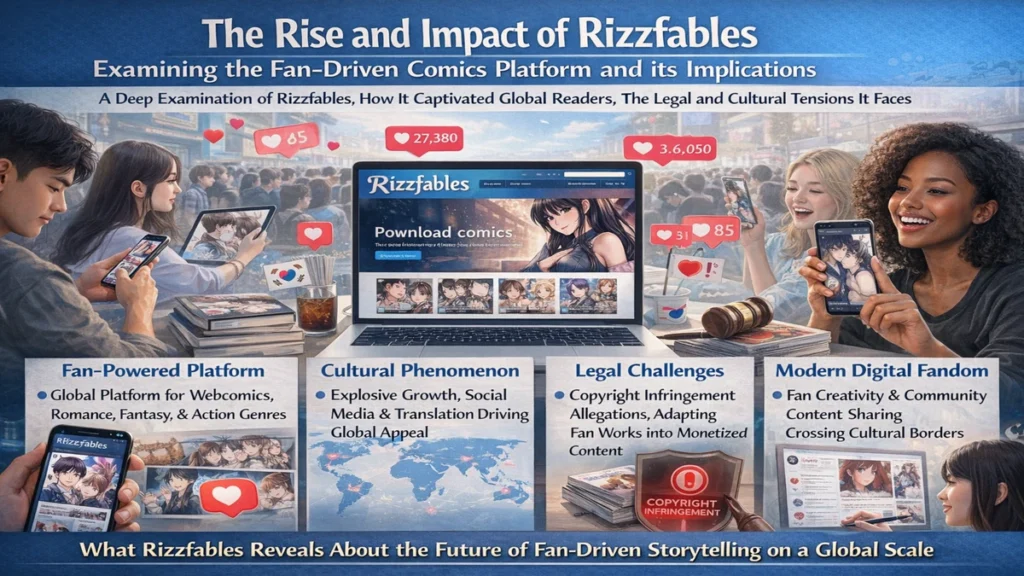
“Rizzfables” are usually trying to figure out what it is, whether it still works, and why it matters. Rizzfables is the name of an online platform that catalogued and hosted access to manga and manhwa series, often through fan-provided translations and community indexing. It became popular because it made a fragmented and confusing global comics ecosystem feel simple. Readers could search, browse, and follow ongoing series in one place without worrying about regional restrictions or release schedules.
The appeal of Rizzfables was not just convenience. It was continuity. For many readers, especially those outside Japan and Korea, official releases were slow, incomplete, or unavailable. Rizzfables offered immediacy and breadth. It gathered fantasy, martial arts, romance, and adventure titles into a single interface that felt intuitive and alive. Over time, this interface became a habitual destination, woven into daily routines in the same way social media or streaming platforms are.
But Rizzfables also existed inside a fragile space. It relied on content that was usually not officially licensed. That placed it at the center of a long-running tension between fans who want open access and creators and publishers who want control and compensation. The story of Rizzfables is therefore not just about a website. It is about how culture moves faster than law, how communities form around shared stories, and how digital platforms shape what people expect from media.
What Rizzfables actually was
At its core, Rizzfables was a catalog and reading interface. It organized thousands of comic titles into categories such as ongoing, completed, dropped, and seasonal. It tracked chapters, provided reading pages, and allowed users to follow series over time. Functionally, it resembled a streaming service for comics, even though it was not licensed in the way Netflix or Spotify are.
The content itself came largely from fan translation communities. These volunteers scanned, translated, edited, and typeset comics that were originally published in other languages. The translations were then uploaded and indexed so that global readers could access them.
Rizzfables did not create the content. It aggregated and presented it. Its value lay in organization, visibility, and convenience. That organizational layer is what made it powerful and controversial at the same time.
Why readers flocked to it
The global demand for manga and manhwa has grown faster than the infrastructure designed to distribute it legally. Licensing negotiations take time. Translation teams are limited. Regional releases are uneven. Readers outside major markets often wait months or years for official versions of stories they are eager to follow.
Rizzfables solved this problem by ignoring borders. It made stories available as soon as fan translators finished them. This created a sense of simultaneity and participation. Readers felt they were experiencing stories as part of a global moment, not as delayed consumers.
There was also a cultural dimension. Genres like isekai, cultivation, and dungeon fantasy developed dedicated international audiences who wanted to explore deep catalogs, not just a handful of mainstream titles. Rizzfables offered that depth.
The community dimension
Over time, Rizzfables became more than a reading site. It became a node in a community network. Readers discussed chapters, shared recommendations, tracked updates, and helped each other find missing series or alternative sources.
This communal layer is essential to understanding why platforms like Rizzfables matter. They are not just repositories. They are social spaces built around narrative.
People do not only want stories. They want to talk about stories. They want to belong to a group that understands their interests. Rizzfables facilitated that sense of belonging, even indirectly.
Legal and ethical tensions
The same features that made Rizzfables attractive to readers made it problematic from a legal perspective. Most of the content it hosted or linked to was copyrighted. Publishers and creators did not authorize its distribution. That meant that, legally, it operated in a gray or outright illegal space.
This tension is not unique to Rizzfables. It exists across digital culture, from music sharing to video streaming to software distribution. The conflict is between frictionless access and structured compensation.
Fans often argue that unauthorized platforms help promote creators, expand audiences, and generate future sales. Rights holders argue that unauthorized distribution undermines their business models and devalues creative labor. Both arguments contain truth, and neither resolves the conflict.
Rizzfables existed in that unresolved space.
Why platforms like Rizzfables are unstable
Because they lack legal standing, fan platforms are inherently fragile. They can be taken down, blocked, or pressured at any time. Domains can change. Servers can go offline. Years of content and community history can vanish overnight.
This instability shapes user behavior. Readers learn to migrate, mirror, archive, and adapt. Communities become nomadic. Loyalty shifts from platform to platform rather than remaining fixed.
Rizzfables’ fluctuations and access issues reflect this pattern. The platform’s story includes not only growth but disappearance, return, fragmentation, and uncertainty.
Comparison of models
| Feature | Fan platforms | Licensed platforms |
|---|---|---|
| Access | Immediate, broad | Controlled, curated |
| Cost | Free | Free or subscription |
| Stability | Fragile | Stable |
| Creator compensation | None or indirect | Direct |
| Legal status | Uncertain | Clear |
| User experience | Fan platforms | Licensed platforms |
|---|---|---|
| Variety | Very high | Limited by license |
| Speed | Fast | Scheduled |
| Quality | Variable | Consistent |
| Ethics | Ambiguous | Transparent |
These contrasts explain why readers often move between both ecosystems rather than choosing one exclusively.
Cultural significance
Rizzfables reflects a deeper cultural shift in how people relate to media. Audiences no longer see themselves as passive consumers. They see themselves as participants in cultural circulation.
Stories move through networks, not pipelines. Fans translate, recommend, remix, and distribute. This does not erase the role of creators, but it does change the shape of authorship and ownership in practice.
Rizzfables embodied this participatory logic. It did not just deliver stories. It enabled a culture around them.
Expert perspectives
Cultural theorists argue that fandom has become one of the primary engines of cultural circulation in the digital age. Media economists note that the tension between access and ownership is reshaping creative industries. Legal scholars point out that copyright law was not designed for a world where distribution costs are near zero.
Rizzfables sits precisely at this intersection of culture, economics, and law.
The future of digital comics
The future likely lies in hybrid models. Licensed platforms are expanding globally, offering faster releases, multiple languages, and free tiers supported by ads. Fans are increasingly willing to support creators when access is fair and timely.
At the same time, fan communities will not disappear. They will continue to translate, archive, and share, especially for niche or older works that fall outside commercial focus.
The story of Rizzfables suggests that the challenge is not to suppress fan culture, but to integrate it into sustainable systems that respect both readers and creators.
Takeaways
- Rizzfables was a fan-driven comics aggregation platform.
- It thrived because it offered global, immediate access.
- It depended heavily on fan translation communities.
- It existed in legal and ethical tension with copyright law.
- Its instability reflects the fragility of unauthorized platforms.
- Its popularity shows unmet demand in licensed distribution.
- It represents a broader shift toward participatory media culture.
Conclusion
Rizzfables was not just a website. It was a symptom and a signal. It showed how strongly people desire access to stories, how communities form around shared narratives, and how digital technology reshapes cultural exchange.
Its rise revealed gaps in official distribution. Its fragility revealed the limits of informal systems. Together, these truths point toward a future where access and sustainability must be reconciled.
Understanding Rizzfables helps us understand the changing relationship between audiences, creators, and platforms in a world where stories travel instantly and borders matter less than ever.
FAQs
What was Rizzfables?
A fan-driven platform that catalogued and provided access to manga and manhwa series.
Why did people use it?
Because it offered fast, broad access to comics that were otherwise hard to obtain.
Was it legal?
It operated in a legal gray area because much content was not licensed.
Why did it become unstable?
Because unauthorized platforms face takedowns, domain changes, and legal pressure.
What replaces it?
A mix of licensed platforms and other fan-run communities.