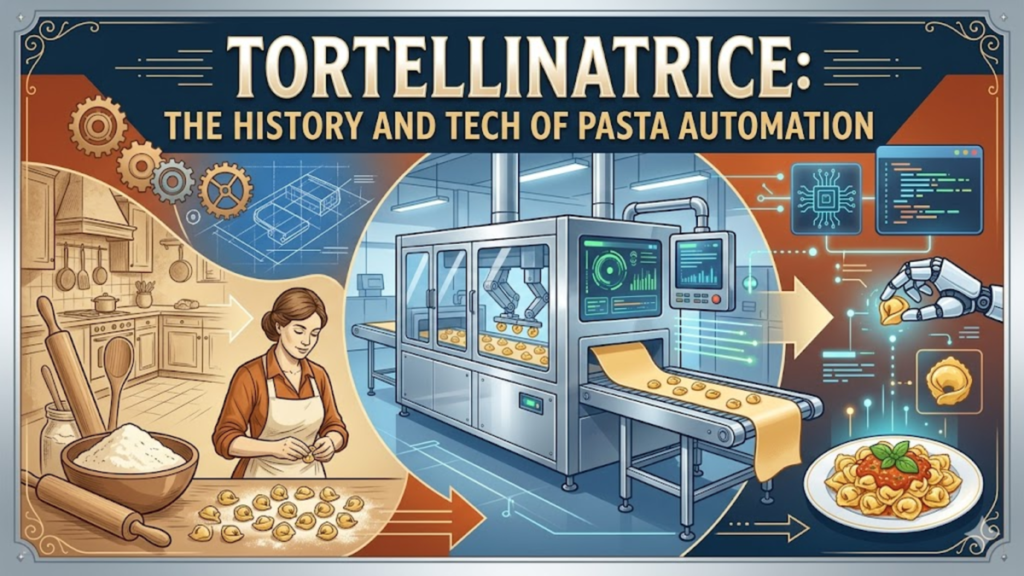
The tortellinatrice is a specialized industrial machine designed to automate the production of tortellini, a ring-shaped pasta traditionally folded by hand. By replicating the complex “pinched and twisted” geometry of traditional pasta, the machine allows for mass production while maintaining the structural integrity of the delicate egg-based dough. In the culinary heart of Italy, where the sfoglia (dough sheet) was once exclusively the domain of the sfogline (skilled pasta-making women), the tortellinatrice represents the definitive bridge between centuries-old craftsmanship and modern food engineering. It solves the primary challenge of industrializing fresh pasta: how to wrap a soft, moist filling within a thin, elastic sheet of dough without tearing the material or compromising the iconic navel-like shape.
For decades, the production of tortellini was a bottleneck in the Italian food industry. While long pastas like spaghetti were easily extruded, the three-dimensional folding of tortellini remained a manual labor of love, limited by the speed of human fingers. The emergence of the tortellinatrice in the early 20th century, pioneered by engineers like Luigi Zamboni, catalyzed a shift that moved tortellini from a regional holiday luxury to a global supermarket staple. Today, these machines operate with surgical precision, utilizing synchronized mechanical “fingers” and vacuum-assisted feeders to produce thousands of units per hour. This evolution has not only preserved the availability of regional Italian specialties but has also standardized safety and hygiene in a sector that was once entirely artisanal.
The Mechanical Renaissance: Engineering the Perfect Pinch
The engineering behind a modern tortellinatrice is a masterclass in cam-driven synchronization. To the untrained eye, the machine appears as a blur of stainless steel, but its operation is a rhythmic sequence of cutting, filling, and folding. First, a continuous sheet of pasta dough is fed through calibrated rollers—often referred to as a “double calibrator”—which ensures the thickness is uniform to within fractions of a millimeter. This is critical; if the dough is too thick, the “knot” becomes unpalatable; too thin, and the machine will rupture the sheet during the folding phase.
Once the sheet is prepared, the machine’s cutting head stamps out small squares or circles. Simultaneously, a pneumatic or mechanical pump deposits a precise dollop of filling—traditionally a blend of pork loin, prosciutto, and Parmigiano-Reggiano—onto the center of each piece. The most complex phase follows: the mechanical “folding unit.” Here, a series of levers and pins mimics the human thumb and forefinger, folding the pasta over the filling to form a triangle and then wrapping the corners around a central spindle to create the signature ring.
Read: Jurivia: The Future of Legal AI and Research (2026)
Comparison of Production Methods
| Feature | Artisanal (Manual) | Industrial (Tortellinatrice) |
| Output Speed | 20–30 pieces per minute | 500–1,200 pieces per minute |
| Consistency | Variable (Human touch) | High (Laser/Sensor precision) |
| Filling Ratio | 30%–40% | 25%–35% (Optimized for seal) |
| Labor Cost | High (Highly skilled) | Low (Technical oversight) |
| Hygienic Control | Individual handling | Closed-system processing |
The Zamboni Legacy: A Case Study in Automation
The history of the tortellinatrice is inextricably linked to the city of Bologna and the Zamboni family. In the late 19th century, Luigi Zamboni, a skilled turner at the Military Arsenal in Bologna, recognized that the growing demand for tortellini could no longer be met by manual labor alone. The Arsenal served as a “school of trade” where mechanical theory met practical manufacturing. Zamboni’s vision was to translate the fluid, organic motions of a sfoglina into a series of gears and cams.
By the early 1900s, Zamboni’s experiments led to the first prototypes of a machine that could replicate the “tortellino.” As noted in the archives of Officine Meccaniche Zamboni (2025), the challenge was not just the shape, but the “feeling” of the dough. The machine had to handle a delicate material that was sensitive to temperature, humidity, and pressure. Zamboni’s success laid the groundwork for an entire sub-sector of Italian manufacturing. By the mid-20th century, companies like Marcato and Facchini Impianti began refining these designs, moving from steam-powered behemoths to the high-speed, PLC-controlled (Programmable Logic Controller) systems used today.
“The tortellinatrice did not just replace the hand; it immortalized the movement of the hand into a permanent mechanical record, ensuring that the ‘navel of Venus’ would never disappear from the Italian table,” says Dr. Paolo Rossi, a historian of industrial food technology.
Modern Innovations and the Global Pasta Boom
The modern tortellinatrice is a far cry from the cast-iron machines of the 1920s. Today’s models, such as the Facchini TA540-S, are constructed entirely of AISI 304 stainless steel to meet stringent international food safety standards. These machines often feature “scrap-cutting units” that instantly recycle the excess dough back into the kneader, minimizing waste and ensuring economic efficiency.
Technological integration has also introduced the use of optical sensors. These sensors detect the presence of the dough sheet and the filling, automatically pausing the line if a misalignment occurs. This level of control is essential for the production of “fresh-frozen” and “ambient-stable” tortellini, which require a perfect seal to prevent spoilage. The transition from manual to mechanical also facilitated the creation of new variations, such as “tortelloni”—the larger, ricotta-filled cousins of the traditional tortellino—which require larger dies and slower mechanical cycles to accommodate the higher moisture content of the cheese.
Evolution of Tortellini Manufacturing Timeline
| Era | Key Development | Impact |
| Pre-1900 | Purely manual production | Restricted to regional/holiday use |
| 1901–1910 | First Zamboni Prototypes | Proof of concept for mechanical folding |
| 1950s–60s | Post-war Industrialization | Mass production for Italian supermarkets |
| 1980s | Vacuum & Thermal Integration | Extended shelf-life and global export |
| 2020s | AI & Sensor Optimization | Near-zero waste and custom recipe memory |
The Economics of the Navel: Market Impact
The introduction of the tortellinatrice changed the economics of Italian food exports. Before mechanization, fresh filled pasta was a “short-distance” product, consumed within days of its creation. The efficiency of the tortellinatrice, combined with advancements in pasteurization and modified atmosphere packaging (MAP), allowed companies like Rana and Fava Storci to export “fresh” pasta across continents.
According to industry reports from Italian Food Tech (2017), the automation of filled pasta has grown at a steady 4.5% annually. This growth is driven by the machine’s ability to handle diverse fillings—from traditional meat to modern vegan and gluten-free alternatives. The flexibility of the modern tortellinatrice allows manufacturers to switch between product lines with minimal downtime, a necessity in a market that increasingly demands variety and “clean label” ingredients.
“The tortellinatrice is the unsung hero of the Italian ‘Economic Miracle’. It took a local craft and turned it into a global powerhouse without stripping it of its cultural DNA,” notes Silvia Valenti, Senior Analyst at the Bologna Chamber of Commerce.
Takeaways: The Mechanical Tortellino
- Precision Geometry: The machine replicates the specific “Venus’s navel” fold, which is essential for the pasta to hold its shape in broth.
- Production Scalability: Modern units can produce over 1,000 units per minute, a feat impossible for manual labor.
- Hygienic Standards: Stainless steel construction and automated cleaning cycles ensure the highest level of food safety.
- Waste Reduction: Integrated scrap-recovery systems ensure that nearly 100% of the dough sheet is utilized.
- Material Sensitivity: Advanced machines use sensors to adjust to the specific “elasticity” of different flour types.
- Global Reach: Automation made tortellini an affordable, accessible staple for international markets.
Conclusion: The Future of the Fold
As we look toward the future of food production, the tortellinatrice stands as a symbol of successful hybridity. It represents a world where technology does not overwrite culture but rather amplifies it. While there will always be a place for the artisanal sfoglina—the hand-made pasta will forever remain the gold standard of the Sunday lunch—the industrial machine ensures that this heritage is not confined to a single province in Italy.
The evolution from Luigi Zamboni’s first turning gears to today’s AI-enhanced production lines proves that the soul of Italian cuisine is not found in the tools used, but in the respect for the ingredients and the final form. The tortellinatrice has effectively “democratized” the tortellino, taking a dish once reserved for the elite and the holiday table and making it a symbol of the “Dolce Vita” accessible to all. As long as the world craves the perfect union of egg-pasta and savory filling, these machines will continue their rhythmic dance, one “pinch” at a time.
Read: MatChem: The Future of Computational Material Science
FAQs
What is the difference between a tortellinatrice and a ravioli machine?
While both machines automate filled pasta, a ravioli machine typically uses two sheets of pasta pressed together to form a “pillow.” A tortellinatrice uses a single sheet, cutting it into circles or squares before performing a complex “pinch and twist” maneuver to create a ring shape around a central hole.
Can these machines handle gluten-free dough?
Yes, but it is challenging. Gluten-free dough lacks the elasticity of traditional wheat dough, making it prone to tearing during the “twist” phase. Modern tortellinatrici use specialized rollers and slower cycle speeds to accommodate these fragile materials.
Who invented the first tortellinatrice?
While several engineers contributed, Luigi Zamboni is widely credited with the first successful mechanical prototype in Bologna during the early 1900s. His work laid the foundation for the company Officine Meccaniche Zamboni.
How is the filling kept inside during high-speed production?
The machine uses a precise dosing pump that deposits the filling at the exact millisecond the pasta sheet is positioned. The “pinch” levers then apply a specific amount of pressure to create a hermetic seal, ensuring the filling does not leak during boiling.
Is machine-made tortellini as good as handmade?
From a structural and hygienic standpoint, machine-made is often more consistent. However, purists argue that machines cannot replicate the microscopic “roughness” of hand-rolled dough, which helps sauce adhere better to the pasta.
References
AXOR Italia. (2026). Industrial pasta production lines: Engineering and raw material analysis. https://axor-italia.com/
Facchini Impianti S.r.l. (2026). TA540-S Tortellini machine: Technical specifications and software management. https://facchini-italia.com/en/products/ta540-s-tortellini-machine/
Fava Storci. (2026). 80 years of success: From 1937 to date in industrial pasta production. https://www.favastorci.com/
Italian Food Tech. (2017, February 14). Fresh pasta, versatility and automation for a high-quality product. https://www.italianfoodtech.com/fresh-pasta-versatility-and-automation-for-a-high-quality-product/
Marcato S.p.A. (2026). Marcato history and Italian pasta machine heritage since 1930. https://www.pasta.kitchen/pages/marcato-history
National Geographic. (2024). The twisted history of pasta: From industrial presses to regional icons. https://www.nationalgeographic.com/history/history-magazine/article/daily-life-pasta-italy-neapolitan-diet
Officine Meccaniche Zamboni. (2025). Our history: 100 years of machines for pasta production. https://www.zamboni-italia.it/omz_STO_F3_ing.htm